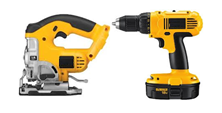
All gas, battery, petrol and plug-in power tools are restricted from carry-on, but they can be checked-in if approved by your airline.
Power tools include nail/bolt guns, drills, skill saws, chain saws, reciprocating saws, and any other power tool designed to cut, slice or drill.
Flex-volt batteries with travel caps, that have combined Watt-hours that exceed 160Wh, will not be permitted to travel on passengers’ aircraft from 20 March 2026.
AvSec previously considered the flex-volt batteries, including DeWalt Flex-volt, as three separate batteries contained in a single case separated by a plastic [transport] safety cap. Advice from AvSec’s Dangerous Goods Regulator confirmed flex-volt batteries are not three separate batteries but are instead a single battery that exceeds the allowable Watt-hour limits. This advice has been informed by international practice where the majority of National Aviation Authorities and airlines treat flex-volt batteries as a single battery.
Power tools can only be carried in checked-in luggage if approved by your airline.
You must take steps to prevent the power tool accidentally turning on. Use trigger locks or secure the on/off switch in the off position with tape.
Spare batteries, including those in moulded cases, must go in your carry-on bag. They are prohibited from checked luggage.
Power tools can be used as a weapon and cause harm to passengers and crew.
You will be asked to relinquish all dangerous or prohibited items found in your carry-on luggage. If you refuse:
AvSec X-ray bags going onto aircraft to ensure there is nothing dangerous in them.
For more information, see Retrieving your removed items.
