Consider others. Be responsible.
This summary is provided for general guidance only and does not constitute a full reading of the Civil Aviation Rules. Please ensure you read the complete rules to understand all requirements and obligations.
Download brochure: Flying your drone safely [PDF 8.4 MB]
Request printed copies of the brochure using our order form.
They’re commonly referred to as drones, but they’re also known as unmanned aircraft or remotely piloted aircraft (RPA).
If you were to carelessly launch a drone from your backyard, there’s a chance that you could be creating a hazard to other aircraft, and people on the ground, as well as breaking aviation law.
The civil aviation rules relating to drones and model aircraft are known as ‘Part 101', 'Part 102', and 'CATI 101-1' Everyone must fly according to those rules – including you.
Get some training to help you fly safely and legally.
Getting an RPA pilot qualification forms part of the requirements to fly less than 4km from an aerodrome.
Training is also required if you intend to fly at night. For more details, refer to Advisory Circular AC101-1.
Find more information about training and a list of approved training organisations, at:
Always keep a respectful – and safe – distance from people and property.
Don't fly directly over peopleUnless they say it's ok. |
|
Don’t fly over propertyUnless the owner says it’s OK. That includes houses, farms, land, private lakes, boats, and vehicles. If it’s public property such as parks, reserves, some beaches, national parks, and other public conservation land, get consent from your local council or the Department of Conservation. |
|
Don’t fly within 4km of an aerodromeUnless you have met all the requirements, including getting aerodrome operator authorisation and an approved pilot qualification. |
|
Stay a safe and considerate distance awayFrom people and buildings. |
|
Keep your drone in sight at all times unless conducting night operations or a beyond visual line of sight operation in accordance with CATI101-1During daylight and when the visibility is good – stay clear of fog and cloud. |
|
Fly no higher than 120m (400ft) above the groundThis keeps your drone below the height of most other aircraft. |
There is certain airspace where drones must never be flown, and other areas where there are strict conditions. These areas include:

|
Low flying zones | 
|
Aerodromes (including airports) |

|
Danger areas |
|
Controlled airspace (air traffic control zones) |
|
|
Military operating areas |
|
Restricted areas |
|
|
See Check the airspace before you fly for more information, including examples and advice on identifying different airspace areas.
To see a map of these areas, or to apply for a clearance to fly your drone within controlled airspace, visit the AirShare website:
A shielded operation allows an operator to fly an RPA near a vertical object(such as trees, buildings, pylons etc) with reduced risk to other aviation participants. Shielded operations can take palce within controlled airspace and within 4km of an aerodrome (but outside its boundary), provided that distance and height criteria specified in CATI 101-1 is adhered to. For additional information, please see AC101-1.
Like any pilot, you need to do a preflight check.
|
Check the techMake sure the battery is fully charged and all drone components are secure and undamaged. |
|
Scan the landYour flying area must be clear of people, animals, or anything that might cause problems, such as powerlines. Get permission if you plan to fly over people or property, or stay well away. |
|
Eyes on the droneYou must always be able to see your drone. Fly it no higher than 120m (400ft) above ground level, and only in daylight, avoiding cloud or fog. |
|
Can you fly here?There are certain areas you can’t fly a drone, or where you need authorisation. Know where you’re allowed to fly, and where you need to ask for clearance first. |
|
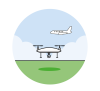
Respect right of wayGive way to, and remain clear of, all manned aircraft on the ground and in flight. If you see an aircraft near you, it may be safest to land. |
These are just a snapshot of the rules. For the full rules, see:
Part 102 Unmanned Aircraft Operator Certification
Be aware if you breach New Zealand civil aviation rules while flying your drone you could face disciplinary action including prosecution.
Want to know more or find this confusing? Consider getting some training to improve your skills and ensure you fly safely and legally. See training to fly drones to find a list of approved training organisations.
See Safety education publications for more educational publications, including more detailed guides on airspace.
Please consider investing in your own knowledge and skills by undertaking a drone pilot course.

 You must never fly in these areas
 You must ensure the hazard will not be unsafe to your flight
 You must get permission before flying in these areas