
Flight instructors aren’t easily impressed, but they say pilots are behaving better in the circuit.
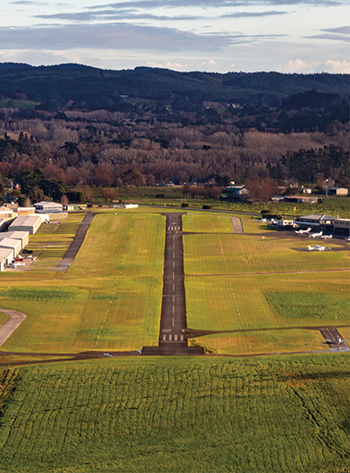
North Shore aerodrome, 2018. Photo courtesy of North Shore Aero Club.
The improvements in circuit flying that instructors are seeing follow the completion of the CAA’s national safety campaign, Work Together, Stay Apart (WTSA). This aimed to reduce mid-air collisions and improve safety at New Zealand’s 161 unattended aerodromes.
When Mike Russell became Chief Flying Instructor of the Hawkes Bay and East Coast Aero Club in 2023, he was concerned that some pilots’ joining practice didn’t look right.
“That observation became the starting point for aligning our practices with the WTSA campaign,” he says.
“Many pilots – especially older ones – were using inappropriate joining procedures. And students flying in the vicinity of Bridge Pa aerodrome, who have English as a second language, were making unclear radio calls.”
Mike says the WTSA presentations by the CAA to the local aviation community – Plane Talking, Circuit Certainty, and the standard overhead join – made a big difference.
“By September 2024, with the Circuit Certainty focus, I saw real progress. Pilots began openly discussing their aircraft quirks and approaches, improving situational awareness. I even witnessed a ‘lightbulb moment’ for one pilot who finally understood the standardised procedure.
“The campaign gave me tools to address the issues we were seeing. It enabled outreach through free instructional sessions on circuit joining, including chalk-drawn diagrams on the ground, which people seemed to relate to.
“Despite these efforts, however, some pilots remained unaware of the reset and standardisation even a year later – highlighting the need for ongoing engagement.”
Mike highlights the importance of biennial flight reviews as a touchpoint with pilots to reinforce the importance of being aware of correct procedures.
“At uncontrolled aerodromes with high traffic, the mix of experienced pilots and students with English as a second language makes this critical.
“I have to say, though, that recently I watched 10 aircraft join overhead – perfectly. This is a scenario unimaginable two years ago. Radio call standards have improved too, thanks to conversations sparked by the campaign and collaboration with the neighbouring flight school.
“I’m grateful to the CAA presenters who took the time to present to us and travel all over the country doing the same thing. As a CFI of a club with 270 members, it’s easy to feel isolated, but the campaign – and CAA’s backing – brought shared experience and solutions.”
At Hokitika Airport on the West Coast, they’ve seen something remarkable because of the WTSA campaign. Chief Executive Melanie Anderson says pilots are talking more, listening better, and flying with greater respect for each other. “It’s safer now,” she says. “You can feel it in the circuit”.
She says since the campaign began, the tone of communication on the airwaves has changed – and noticeably for the better.
“Overall, there’s been a marked positive difference. We hear pilots – itinerant and local – communicating more clearly, using plain language, and showing greater collaboration when entering, leaving, or operating in shared airspace.”
Where radio exchanges once sounded a bit clipped and mechanical, they now feel friendlier and more human.
“Pilots are engaging with each other as people, not just as planes.”
That change in communication style has also influenced how pilots behave in the circuit. “People seem more cooperative, more willing to give way, rather than insisting on their own path,” Melanie says.
“From my observation, flying in the circuit seems more fluid now, with pilots flowing in and out of the airspace instead of hustling or forcing their way. There’s more politeness and mutual respect, which makes everything smoother.”
The result? Safer skies. “There have been no reported issues here, which shows operations are running more safely for everyone.”
Still, not all pilots have embraced all of the standard procedures.
“Some are resistant and prefer their old habits,” Melanie acknowledged. “But if we could lift adoption of the proper procedures from around 80 percent to 90 percent, it would significantly improve safety, as well as the overall flying experience.”
With the campaign now complete, local organisations are keeping the momentum alive.
“We use positive reinforcement in group meetings to highlight good communication and remind people of best practices,” Melanie says.
“If there’s a slip, it’s addressed individually, often via the Hokitika Aero Club. We work closely with the club to ensure consistent messaging and shared safety goals.”
Even those who aren’t in the cockpit have a role to play. “We support the flying community by reinforcing good behaviours and coordinating with the aero club,” says Melanie.
“Safety improvements depend on cooperation between multiple organisations, not just pilots.”
Looking ahead, Melanie says the message is clear – programmes like WTSA have lasting value.
“Campaigns like this are very beneficial and should continue. Even smaller, ongoing initiatives – regular reminders, positive reinforcement – will help sustain these good habits across the aviation community.”
Celine Bennison, Chief Flight Instructor and Operations Manager at South Canterbury Aero Club at the time of the campaign, says they’ve seen a noticeable reduction in non-standard activity since the campaign began.
“Licensed pilots set a good example, which really sinks in for students and makes flying safer for everyone.
“The campaign has shifted pilots’ willingness to improve. Even those flying for decades are now more receptive to making changes, and the campaign materials have given us the tools to have open conversations about procedures and safety practices.
“Students and club members are asking, ‘What’s next?’ The campaign has sparked an appetite to keep learning and improving, which helps strengthen safety for everyone.
“There will always be some pilots who resist, but engagement and open discussion are helping to change that culture and reduce stigma around authority.”
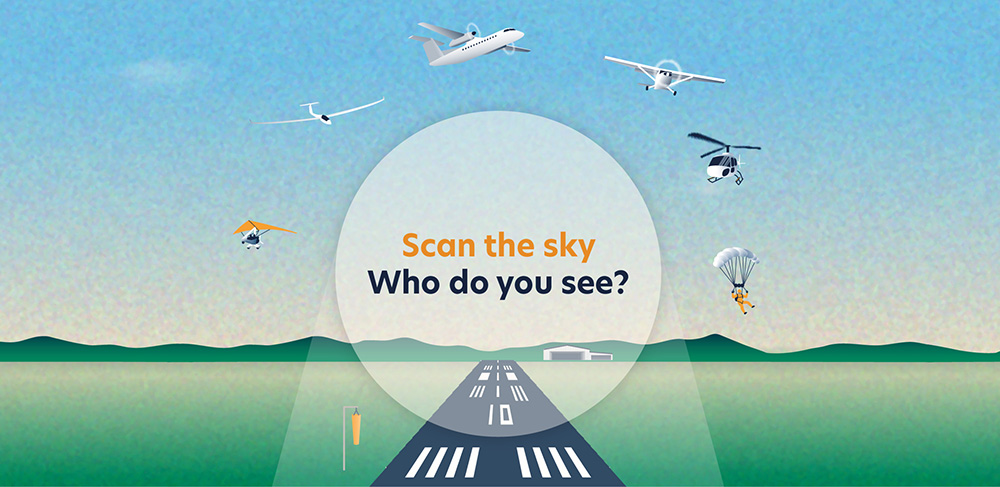
Graphics source: WTSA campaign/Gusto Design.
Research backs up the claims
A research report from Massey University’s School of Aviation supports the perceptions of improved safety at unattended aerodromes.
The survey, conducted after WTSA finished in mid-2025, captured feedback from 634 participants. Most were male pilots of fixed-wing aircraft, with an average flying experience of 24 years.
Seventy-six percent of respondents perceived unattended aerodromes as safer since the WTSA campaign started, and 78 percent said their behaviours at these aerodromes will now be safer.
Around 28 percent of respondents noticed mostly positive behavioural change in users of unattended aerodromes since the campaign started, including:
- more overhead joins
- adhering to standard procedures
- better radio calls
- better circuit etiquette, and
- greater attention to lookout.
The lead researcher, Professor Andrew Gilbey, says he views this as positive and significant. He says in aviation, where safety is constantly being improved, even relatively modest changes are likely to be significant.
He emphasises that a clear majority of respondents believe unattended aerodromes have become safer since the campaign.
He also noted that 85 percent of respondents reported they had engaged to some degree with the campaign, which he believes, “…reflects highly on the culture of New Zealand pilots”.
And 77 percent said the campaign had increased their knowledge of flying around unattended aerodromes.
Perception of invulnerability
 The report says most pilots still think they’re less at risk than others when doing non-standard manoeuvres. This ‘it won’t happen to me’ mindset shows a perception of invulnerability.
Pilots correctly identified unattended aerodromes as riskier than controlled ones. But, interestingly, they tended to overestimate the risk of mid-air collisions – although, not to them.
“This perception of invulnerability was especially evident among experienced pilots – those with greater hours tended to rate themselves as less at risk,” says Andrew Gilbey.
More than half of respondents rated their airmanship as above average – an overestimation, Andrew says, since only about half of any group can be above average.
“Therefore, at least some of those who believed they were personally unlikely to perform risky manoeuvres that breach procedures at unattended aerodromes may be overestimating their ability.”
Campaign engagement
The campaign aimed to reduce mid-air collisions and promote best practice at unattended aerodromes by:
- improving predictability
- creating a shared understanding of standard procedures
- strengthening airmanship
- encouraging collaboration among pilots and operators, and
- avoiding the hazard of conflict.
More than 3500 people participated in 84 seminars across 31 locations nationwide, with additional engagement via social media, workshops, and print materials, including Vector.
What’s next?
 The CAA’s Charlotte Brogan, WTSA campaign lead, says ongoing education and reinforcement is essential if the effects of the campaign are to be maintained over time.
“The CAA will continue to share messages regarding safe flying near unattended aerodromes.
“Reports to the CAA reflect an overall downward trend in airborne conflict events at unattended aerodromes, although there was a spike during the September- December period in 2024 in reported events. But this may be due to increased reporting through a heightened awareness of the significance of these types of events, in addition to the busy summer period,” Charlotte says.
CAA Aviation Safety Advisor and Flight Examiner Carlton Campbell was deeply involved with the WTSA campaign. “The videos and other educational materials are still available on the CAA website for anyone who missed them during the campaign or wants to refresh their memory. That would contribute to consistent, compliant, standardised, predictable activity around the airfield and make it safer.
“The onus now, as it has always been, is on the general aviation community to pick up and run with the principles raised in WTSA to keep the ethos of the campaign alive.
“We all need to keep working towards safety at unattended aerodromes to reduce the likelihood of a mid-air event occurring in the future.”
More information
Visit the Work Together Stay Apart campaign page, and read the evaluation report.
Main image: WTSA campaign/Gusto Design