
Everyday items lost in the cockpit, foreign object debris (FOD), can jam essential controls. Two such incidents occurred in 2025.
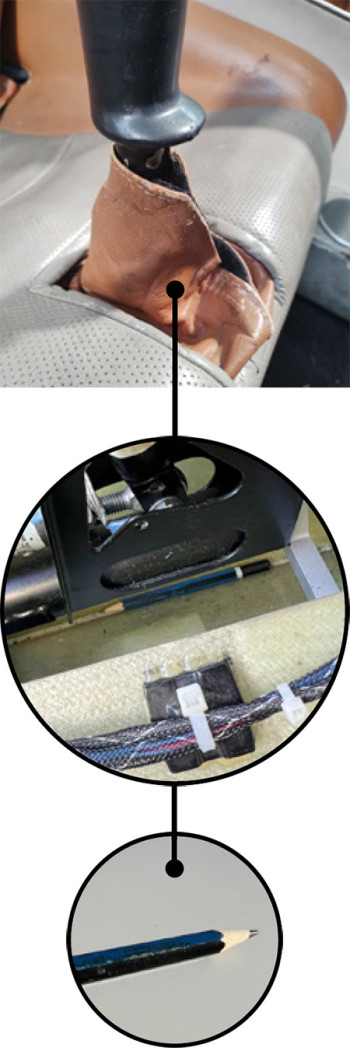
This virtually unscathed pencil caused a life-threatening event. Photos courtesy of the training school.
Earlier this year, a PPL-holder was carrying out training towards their CPL.
They were flying solo, and at about 650ft AMSL, they rolled out of a right-hand turn. Suddenly, their control stick became difficult to manoeuvre in any direction.
The pilot advised ATC of the problem. They then attempted to free both control sticks on the training aircraft using full force, in every direction. It was unsuccessful.
Facing a life-threatening situation and requiring immediate help, they declared a MAYDAY.
Even with restricted elevator and aileron control, the pilot could control the direction using rudder inputs. Likewise, altitude and speed could be controlled using power and elevator trim inputs.
The pilot lined up for a 2.5NM final to give themselves time to stabilise the approach. The aerodrome-based emergency services were brought online, while Fire and Emergency NZ and the ambulance service were notified.
The pilot was in contact with senior instructors from the training organisation. They advised a flapless landing, as increased airflow over the aircraft would improve the effectiveness of the pilot’s remaining control inputs.
At 50ft AGL, the pilot initiated a go-around, as they were too high and too unstable. A second 2.5NM final was attempted – this time with approach flaps extended to allow them to reduce their speed slightly.
This second attempt at a slightly slower speed of 65 to 75 knots was successful.
When the aircraft contacted the runway, it bounced slightly, freeing the control stick slightly. The pilot used force to completely free it.
The aircraft then taxied to the hangar without further incident.
Grounding the fleet
Following this incident, the training school’s entire fleet was grounded, says the organisation’s safety manager.
This decision was costly.
“We lost an afternoon of flying on a beautiful day, but we didn’t know what had happened, and we just couldn’t take that risk.
“There was a comprehensive check of the aircraft in question. When the seats were removed, a pencil was found under the right-hand control stick mechanism.
“This pencil had indentations on it consistent with it being jammed in the control stick mechanism.
“It was a relief finding that pencil. But I know we made the right call grounding the fleet, just in case.”
The safety manager is unsure how the pencil made its way down into the control mechanism.
“The control stick is protected by a leather sheath.
“FOD in the cockpit is something everybody needs to be aware of.”
April fool’s
Several months earlier, a similar event took place during a dual flight training exercise.
A senior aerobatics instructor was teaching a student how to recover from a spin. The student was training for their own instructor rating.
“I was demonstrating the manoeuvre first,” the instructor says. “They were going to perform it afterward.
“During pre-take offs, everything was normal. I always triple check the controls before aerobatics.
“Nothing peculiar happened during straight and level flying, or during climbing and turning.”
But during the first spin and recovery, the instructor noticed something was wrong.
“I’ve done a lot of spinning in that aircraft, so I know what’s normal and what’s not,” she says.
“On this occasion, the stick forward pressure – for the recovery of the spin – required more than normal. I thought, ‘This doesn’t feel right’.”
The instructor wondered if the trim was out. She adjusted the setting to remove pressure from the control stick and performed another spin.
“It made no difference. I had to make the call. I said to the student, ‘Look, the pressure that’s needed to be held isn’t right – we’ll have to cancel the lesson for today’.
“On the way back in, the controls felt normal again. When the engineers had a look over the aeroplane, they couldn’t find anything.”
The instructor almost let it go but instinct told her to double-check.
“I said to the engineers, ‘That’s all the more reason to look a bit further. Open it up and have a look inside’.
“I didn’t think they were going to find anything. When the engineers called me over and showed me the pen they’d recovered from the empennage, I thought it was a prank. It was the first of April.
“When I realised it wasn’t a joke, I was actually shocked.”
The instructor isn’t sure how the metal pen made its way to the back of the aircraft.
“It was wedged in between a bolt and the wire elevator control. The marks on the pen suggest it’d been there a while.
“The best policy to avoid something like this happening, is to to make certain you take anything away with you which you bring into the cockpit.
“It’s also a lesson to follow your instinct. If something doesn’t feel normal, get it checked out. You shouldn’t just dismiss it.”
The instructor also agrees with the training organisation in the first FOD instance, that safety should be prioritised over profit.
“In the end, commercial interests are protected by prioritising the safety of the flight.
“The cost of something going horribly wrong would be significantly greater.”
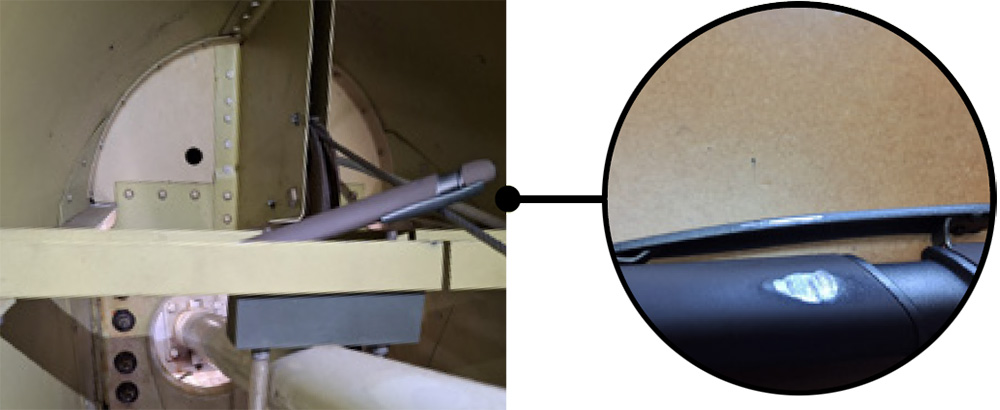
This virtually unscathed pen could have caused havoc in the middle of an aerobatic spin. Photos courtesy of the aerobatics instructor.