
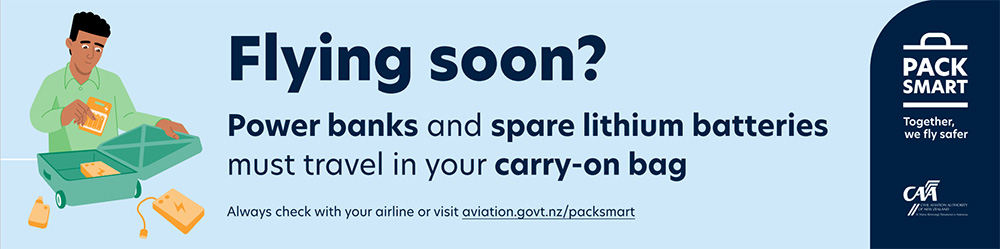
 The CAA has launched one of its most expansive campaigns ever – to get airline passengers to bring lithium batteries, and the devices they power, into the cabin.
Lithium battery incidents on aircraft are increasing. Passengers are travelling with more personal electronic devices (like cellphones and ear buds) and the size of the batteries in devices is also increasing.
While New Zealand’s civil aviation operators are, hopefully, very aware of the dangers of lithium battery fires, recent research has indicated their passengers are not.
So the CAA has embarked on its widest public campaign yet – to inform passengers of the critical need to carry power banks and spare lithium batteries in the cabin. It’s also strongly recommending that all spare batteries (of any type) and personal electronic devices (PEDs) are also carried in the cabin.
Why?
Globally, there are at least two lithium battery fires per week within the cabin on air transport aircraft.
This includes a full-scale emergency response to a possible hold fire on a Qantas trans-Tasman flight, in September 2025. And a few months earlier, a lithium battery fire in an overhead bin, as a Virgin Australia flight descended into Hobart.
In 2024, a staggering 250,000 batteries were removed from hold luggage by AvSec officers in New Zealand.
Recent incidents of such fires show that power banks are particularly dangerous. They can ignite or explode with little warning.
Devices such as hoverboards, scooters, and drones present their own risk, because they’re more likely to be used on a daily basis. This increases the likelihood of their batteries – which may all be manufactured according to different standards – becoming damaged. They’re also much more likely to be damaged through daily use. They can overheat and catch fire or explode without warning. Some operators have prohibited these higher risk devices from being on their aircraft.
E-cigarettes are also dangerous. They can be easily activated, causing their temperature to rise quickly. In some cases, they may explode and ignite nearby items.
The US Federal Aviation Administration tested a fully charged laptop in a checked bag. The test showed that if the PED were to start a thermal runaway and catch fire alongside permitted hazardous materials like cosmetics, there’s a low chance that the cargo compartment fire protection systems could contain the blaze.
The test concluded that the risk of an uncontrolled cargo fire would be very high. The risk of transporting PEDs – such as phones, laptops, or tablets – in checked baggage has been further validated by research from the European Aviation Safety Authority.
Despite the difficulty in controlling a lithium battery fire, if the smoke from one becomes apparent in the cabin, flight attendants have the equipment and training to manage the fire quickly and safely.
But in the cargo hold, at present, very little can be done.
What you must do
 So, with its Pack smart, play your part campaign, the CAA wants airline passengers to become ‘lithium battery-aware’. But it also wants participant organisations who carry passengers to appreciate their obligation to tell their passengers of the potential danger.
The word ‘must’ in the civil aviation rules is of particular significance. If ‘must’ is in a direction, you have no choice in the matter.
And so it is with rule 92.179 Information to passenger.
You must inform passengers of prohibited goods that are forbidden from being anywhere on the aircraft – this includes dangerous goods. Examples are camping gas cannisters, damaged lithium batteries, and most explosives.
According to the rule, this must – that word again – be done through plenty of written notices prominently displayed where:
- flight tickets are issued
- baggage is checked in
- passengers board
and also with:
- a physical ticket, or
- if no physical ticket, as part of the booking confirmation.
Then there are the items allowed on board the flight, but their carriage is limited in some way – that includes all types of batteries and battery-powered devices.
You should inform your passengers of the restrictions of having these on board. And get them to acknowledge they’ve understood that information before they get on the aircraft.
Changes to regulations
The International Civil Aviation Organization (ICAO) is expected to introduce changes in early 2026 placing further restrictions on carrying power banks. The upcoming changes will mean power banks:
- must not be charged while on board an aircraft
- should not be used to charge a portable device while on board and
- no one can carry more than two power banks, each.
ICAO also recommends you advise passengers to carry their power banks in a seat pocket, or under the seat, rather than in the overhead locker. (If they do ignite, it’s harder for crew to put out the fire in an overhead locker).
Carrying power banks in checked baggage will remain prohibited.
All operators are responsible for implementing and communicating these changes from ICAO, and passengers must follow the restrictions.
The campaign
The CAA is joining with other national aviation authorities around the world in tackling this critical issue, over the busy southern hemisphere summer.
Messages to passengers will be everywhere – television, radio, websites, highway billboards, social media, and full-page advertisements in national newspapers.
The campaign involves, not just the CAA, but also airlines, airports, retailers (of goods containing lithium batteries) and organisations working at aerodromes around the country.
“We may have had other national campaigns, such as Work Together, Stay Apart,” says Jim Finlayson, CAA’s Principal Advisor, Dangerous Goods, “but this campaign is much broader. As well as operators, we’re targeting passengers and their responsibilities for keeping themselves, and everyone else safe.
“If we can prevent a single in-flight fire, the campaign will more than pay back the time, energy, and funding to put it together.
“An in-flight lithium battery fire is still, thankfully, rare – although becoming more common – but the consequences could obviously be catastrophic.
“If we have every stakeholder involved and motivated to create the highest passenger awareness possible, we will all have done everything we can to mitigate the frightening risk these batteries present.”
Now read…
…your obligations as an air transport operator to inform your passengers about the dangers of lithium batteries, go to Passenger and crew awareness on the risks of lithium batteries.
Vector Online: Lithium batteries – The good, the bad, and the ugly
Vector Online: Lithium battery fires do happen here