Note: This is the original issue of Part 135, not the current consolidation.
Part 135 - initial issue [PDF 1.2 MB]
Return to main section for Part 135
This Part prescribes rules governing air transport operations and commercial transport operations using—
(1) aeroplanes having a seating configuration of 9 seats or less, excluding any required crew member seat, and a MCTOW of 5700 kg or less, except when they are used for SEIFR passenger operations; and
(2) helicopters.
In this Part—
AFCS means automatic flight control system:
Air operation means an air transport operation or a commercial transport operation, except a SEIFR passenger operation, using—
(1) an aeroplane having a seating configuration of 9 seats or less, excluding any required crew member seat, and a MCTOW of 5700 kg or less; or
(2) a helicopter:
Air operator certificate means an airline air operator certificate or a general aviation air operator certificate:
Consolidation means the process by which a person, through practice and practical experience, increases proficiency in newly-acquired pilot operating knowledge and skills:
Exposition, unless the context otherwise requires, means the exposition required by rule 119.81 or 119.125:
Helicopter external sling load means the external carriage, lowering, or picking up, of a load, cargo, or passengers by a helicopter by means of a bucket, net, harness, sling, or stretcher, suspended beneath the helicopter:
Holder of an air operator certificate means the holder of an air operator certificate issued in accordance with Part 119 that authorises the holder to conduct an air operation:
Net take-off flight path, take-off flight path, take-off distance, and takeoff run have the same meaning as prescribed in the rules under which the aeroplane was certificated:
SAS means stability augmentation system:
Threshold means that point where a 1:20 obstacle-free approach surface intersects the runway surface.
Each holder of an air operator certificate must take reasonable care to ensure that all persons employed, engaged, or contracted by the holder of an air operator certificate to perform aviation activities, are familiar with the appropriate sections of the Act, Civil Aviation Rules, and procedures specified in the certificate holder’s exposition.
Each person performing an air operation must conform with the applicable procedures specified in the exposition of the holder of the air operator certificate that authorises the operation.
If a crew member completes a test, flight check, or assessment, that is required under Subparts I or J within 60 days before the date on which the test, flight check, or assessment is required, the crew member is deemed to have completed the test, flight check, or assessment on the date that it is required to be completed.
In addition to the requirements in rule 91.211, each person performing a commercial transport operation must ensure that each passenger receives additional briefing or training in safety and emergency procedures appropriate to the characteristics of the flight operation.
(a) Each holder of an air operator certificate must ensure that each aircraft it uses in conducting an air transport operation has a current standard category airworthiness certificate.
(b) Each holder of an air operator certificate must ensure that each aircraft it uses in conducting a commercial transport operation has—
(1) a current standard category airworthiness certificate; or
(2) a current restricted category airworthiness certificate provided that the aircraft flight manual allows such an operation.
Each holder of an air operator certificate must ensure that—
(1) all crew members can communicate in a common language with at least one flight crew member being able to communicate in the English language; and
(2) all operations personnel are able to understand the language in which the applicable parts of the certificate holder’s exposition are written.
(a) The holder of an air operator certificate must ensure that for each air operation conducted under the authority of that certificate, appropriate information is available to the pilot-in-command to complete the preparation for the intended operation.
(b) The holder of an air operator certificate must ensure that prior to each—
(1) air transport operation; and
(2) commercial transport operation where passengers or goods are carried from or to a remote aerodrome,
conducted under the authority of that certificate, a flight plan meeting the requirements of rule 91.307(c) or 91.407 as appropriate for the type of operation is prepared, and if the flight plan is not prepared by the pilot-in-command, the pilot-in-command is informed of the contents of the flight plan before the intended operation.
(c) A VFR flight plan prepared under paragraph (b) in accordance with the requirements of rule 91.307(c) may incorporate multiple route segments provided that the SARTIME is amended for the next aerodrome of intended landing as the flight proceeds.
(d) The holder of an air operator certificate performing an air operation under VFR to an aerodrome where communications cannot be maintained, must ensure that prior to any such air operation —
(1) the flight plan required by paragraph (b) includes a SARTIME for when the next communication with an ATS unit will be established; or
(2) where the operation is covered by a flight following service under rule 119.73(b) or 119.121(b), the person providing the flight following service is given a time for re-establishing communications.
(e) Except as provided in paragraph (f) the holder of the air operator certificate must ensure that the flight plan required under paragraph (b) is submitted to an appropriate ATS unit.
(f) Except as required by rule 91.307(a)(1), a flight plan is not required to be submitted to an ATS unit if —
(1) the air operation is a VFR flight; and
(2) the operation is covered by a flight following service under rule 119.73 or 119.121; and
(3) the requirements under rule 119.73(b) or 119.121(b) are met; and
(4) the pilot-in-command maintains a listening watch on the appropriate ATS radio frequency.
(g) Notwithstanding rules 91.307(a) and 91.407(a)(1), the flight plan required to be submitted to an ATS unit under paragraph (e) may be submitted by the holder of the air operator certificate and the pilot-in-command must be informed of the contents of the flight plan.
(a) Each holder of an air operator certificate must have available, for immediate communication to rescue coordination centres, information on the emergency and survival equipment carried on board each of its aircraft.
(b) For air operations performed in excess of 10 NM from shore the information required by paragraph (a) must include—
(1) the number, colour, and type of life rafts; and
(2) whether pyrotechnics are carried; and
(3) details of emergency medical supplies and water supplies; and
(4) the type and operating frequencies of any emergency portable radio equipment.
(a) Each holder of an air operator certificate must establish a fuel policy for the purpose of flight planning, and en-route replanning, to ensure that each aircraft carries sufficient fuel, including reserve fuel, for the planned flight.
(b) The fuel policy must ensure that the planning of fuel requirements is based upon—
(1) procedures, tables, and graphs, that are contained in, or derived from, the manufacturer’s manuals and that conform to the parameters contained in the aircraft’s type certificate; and
(2) the operating conditions under which the planned flight is to be conducted.
(c) Each holder of an air operator certificate must ensure that the calculation of useable fuel required for a flight takes into account the following factors:
(1) taxi fuel:
(2) trip fuel:
(3) reserve fuel, consisting of—
(i) contingency fuel; and
(ii) alternate fuel, if an alternate aerodrome is required; and
(iii) final reserve fuel; and
(iv) additional fuel, if required by the type of operation:
(4) if applicable, fuel required for en-route re-planning.
(d) Each person flight planning or en-route replanning an air operation must comply with the fuel policy required by paragraph (a).
(a) Each holder of an air operator certificate must, for each air operation, ensure that flight crew members have available for use a cockpit checklist covering the procedures, including emergency procedures, for the operation.
(b) Each person performing an air operation must establish and use an appropriate practice for cockpit checks covering the procedures, including emergency procedures, for the operation of the aircraft in accordance with the aircraft flight manual.
(a) Each person performing an air operation must ensure that—
(1) any passenger who appears to be under the influence of alcohol or drugs or exhibits behavioural characteristics, to the extent where the safety of the aircraft or its occupants is likely to be endangered, is refused embarkation or, where appropriate, removed from the aircraft; and
(2) disabled passengers are appropriately cared for, including allocation of appropriate seating positions and handling assistance in the event of an emergency; and
(3) escorted passengers do not constitute a safety hazard to other passengers or to the aircraft, and that prior arrangements for their carriage have been made in accordance with procedures in the certificate holder’s exposition.
(b) Notwithstanding (a)(1), where an operation is conducted for the purpose of search and rescue or is an air ambulance operation, passengers may be carried who are under the influence of alcohol or drugs or exhibit behavioural characteristics to the extent where the safety of the aircraft or its occupants is likely to be endangered, provided that reasonable action is taken by the operator to minimise the risk to the aircraft and its occupants from such passengers.
(a) Except as provided in paragraph (b), a person must not manipulate the controls of an aircraft performing an air operation.
(b) A holder of an air operator certificate must take reasonable care to ensure that a person does not manipulate the flight controls of an aircraft performing an air operation under the authority of the certificate, unless the person is—
(1) a flight crew member; or
(2) an authorised representative of the Director who—
(i) has the permission of the certificate holder and the pilot-in- command; and
(ii) is performing a required duty.
(a) Each flight crew member must ensure that, when a cockpit-voice recorder is required by rule 135.367—
(1) it is operated continuously from the start of the checklist commenced before engine start until the completion of the final checklist at the termination of flight; and
(2) if the helicopter is equipped to record the uninterrupted audio signals received from a boom or a mask microphone, boom microphones are used below 10 000 feet altitude; and
(3) if an erasure feature is used in the cockpit-voice recorder, only information recorded more than 30 minutes earlier than the last record is erased or otherwise obliterated.
(b) Each flight crew member must ensure that, when a flight data recorder is required by rule 135.369—
(1) it is operated continuously from the instant the helicopter begins the take-off until it has completed the landing; and
(2) all recorded data is kept until the helicopter has been operated for at least 10 hours after each operating cycle; and
(3) no more than 1 hour of recorded data is erased for the purpose of testing the flight recorder or the flight recorder system; and
(4) any erasure made in accordance with paragraph (b)(3) is—
(i) of the oldest recorded data accumulated at the time of testing; and
(ii) recorded in the appropriate maintenance documentation.
(a) Despite the requirements of rule 91.15(3), a person operating an aircraft under the authority of an air operator certificate issued in accordance with Part 119 may refuel or defuel the aircraft with a Class 3.1C or a Class 3.1D flammable liquid when a person is embarking, on board, or disembarking the aircraft, if the person operating the aircraft ensures that safety and aircraft evacuation precautions are taken in accordance with procedures specified in the certificate holder’s exposition.
(b) A person operating an aircraft under the authority of an air operator certificate issued in accordance with Part 119 may refuel or defuel the aircraft with a Class 3.1C or a Class 3.1D flammable liquid with one or more propulsion engines running if—
(1) the person ensures that safety and aircraft evacuation precautions are taken in accordance with procedures specified in the certificate holder’s exposition; and
(2) the pilot-in-command is responsible for every aspect of the fuelling operation.
(a) A holder of an air operator certificate must ensure that an aeroplane performing an air operation under the authority of the holder’s certificate does not use an aerodrome for landing or taking-off unless—
(1) the aerodrome has physical characteristics, obstacle limitation surfaces, and visual aids that meet the requirements of—
(i) the characteristics of the aeroplane being used; and
(ii) the lowest meteorological minima to be used; and
(2) if the operation is a regular air transport service operating to, from, or outside of New Zealand, —
(i) each runway at an aerodrome within New Zealand that is used for the operation is provided with a RESA at each end of the runway in accordance with the requirements of Part 139 Appendix A.1; or
(ii) if the runway does not have a RESA as required in paragraph (a)(2)(i), the certificate holder ensures that the take-off and landing performance calculations for the aeroplane are based on a reduction of the appropriate declared distances for the runway to provide the equivalent of a 90m RESA at the overrun end of the runway strip; and
(iii) each runway at an aerodrome outside of New Zealand that is used for the operation has a RESA that extends to at least 150m from the overrun end of the runway, or an engineered equivalent that is acceptable to the Director; or
(iv) if the runway does not have a RESA or an engineered equivalent as required in paragraph (a)(2)(iii), the certificate holder ensures that the take-off and landing performance calculations for the aeroplane are based on a reduction of the appropriate declared distances for the runway to provide the equivalent of the RESA required in paragraph (a)(2)(iii) at the overrun end of the runway.
(b) A holder of an air operator certificate must ensure that any heliport used in its air transport operations meets the applicable requirements of Part 91.
(c) If an aeroplane operated under the authority of an air operator certificate uses an aerodrome that is not promulgated in the AIPNZ, the holder of the air operator certificate must maintain a register containing—
(1) the aerodrome data; and
(2) procedures to ensure that the condition of the aerodrome is safe for the operation; and
(3) procedures to ensure that the condition of any required equipment, including safety equipment, is safe for the operation; and
(4) details of any limitations on the use of the aerodrome.
(d) A holder of an air operator certificate must ensure that an aeroplane that is operated VFR by day under the authority of the holder’s certificate does not use any place for the purpose of landing or taking-off unless—
(1) the runway used has—
(i) a width that is at least twice the outer main gear wheel span of the aeroplane; and
(ii) a surface without irregularities and of sufficient strength for take-off and landing for the aeroplane being used; and
(2) the width of the runway strip surrounding the runway being used is at least two and a half times the wingspan of the aeroplane, or 30 m, whichever is greater.
(e) A holder of an air operator certificate must ensure that an aeroplane, operated under the authority of the operator’s certificate, that is not operated in accordance with paragraph (d) does not use any place for the purpose of landing or taking-off unless—
(1) the aerodrome reference code of the aeroplane being used is determined by reference to Table 1 of Appendix C; and
(2) the runway width is at least that width determined by reference to the aeroplane code number in Table 2 of Appendix C; and
(3) the minimum runway strip width for the runway used is determined by reference to Table C-1 of Appendix C of Part 139.
(f) Notwithstanding paragraphs (d) and (e), a holder of an air operating certificate may use a lesser minimum runway width than that required under paragraph (d) or (e) for an aeroplane type if—
(1) a lesser minimum runway width determined by certificated flight testing is prescribed in the aeroplane’s flight manual; or
(2) a lesser minimum runway width is acceptable to the Director; or
(3) a lesser minimum runway width was prescribed for the aeroplane in an air service certificate, issued to the holder of the air operator certificate under regulation 136 of the Civil Aviation Regulations 1953 before 6 January 1993.
A person must not perform an air operation carrying passengers with a single-engine aircraft under IFR.
Each holder of an air operator certificate must, on becoming aware of any condition that is a hazard to safe operations, restrict or suspend operations as necessary until the hazard is removed.
(a) Rule 91.311(c) does not apply to a pilot-in-command of an aircraft performing an air transport operation.
(b) Notwithstanding rule 91.311(c)(4), a pilot-in-command of an aircraft performing a commercial transport operation may, if necessary for the proper accomplishment of the operation, conduct approaches, departures, and manoeuvres below a height of 500 feet above the surface within the horizontal radius of 150 metres of any person, vessel, vehicle, or structure if the pilot-in-command—
(1) prepares a plan for the operation in conjunction with every person and organisation involved in the operation; and
(2) takes reasonable care to conduct the operation without creating a hazard to any person or property; and
(3) briefs every person and organisation involved in the operation on the plan required by paragraph (b)(1).
(a) A person performing an air operation must not operate over water more than 10 NM beyond gliding or autorotational distance from shore unless—
(1) life rafts are carried of sufficient rated capacity to carry every occupant of the aircraft; and
(2) a life preserver is worn by each passenger.
(b) A person performing an air operation in a single engine helicopter must not operate over water more than 10 NM beyond autorotational distance from shore unless—
(1) the helicopter is equipped with an operable flotation device; or
(2) each occupant is wearing an immersion suit.
(c) The operator of a multi-engine aircraft may, instead of the requirement in paragraph (a)(2), have life preservers available for use in a position accessible to each passenger.
(d) A person performing an air transport operation over water beyond 100 NM from shore must conduct the flight under IFR.
(a) Each holder of an air operator certificate must ensure action plans are developed for handling in-air and on-ground emergency situations and minimising risk of injury to persons.
(b) The certificate holder’s emergency situation action plan must be based upon data including but not restricted to—
(1) type and length of routes over which operations are carried out; and
(2) aerodrome ground facilities; and
(3) local emergency services; and
(4) ATC facilities; and
(5) type, seating configuration, and payload of the aircraft likely to be involved.
(c) The certificate holder’s in-air emergency plan must include the following—
(1) if management personnel become aware of an emergency situation arising on an aircraft during flight that requires immediate decision and action, procedures to be followed by those personnel to ensure that—
(i) the pilot-in-command is advised of the emergency; and
(ii) the decision of the pilot-in-command is ascertained; and
(iii) the decision is recorded; and
(2) if management personnel are unable to communicate with the pilot-in-command in accordance with paragraph (c)(1), procedures to be followed by those personnel to ensure that—
(i) an emergency is declared; and
(ii) any action considered necessary under the circumstances is taken.
(d) Each holder of an air operator certificate must ensure appropriate staff are trained and competent to perform their duties during emergencies in accordance with the emergency situation action plan.
(a) Notwithstanding rule 91.311(a)(1), a pilot-in-command of a helicopter may perform a commercial transport operation over a congested area of a city, town or settlement at a height less than 1000 feet above the surface or any obstacle that is within a horizontal radius of 600 metres from the point immediately below the helicopter if—
(1) a plan for the operation is prepared containing—
(i) a chart depicting flight areas and altitudes; and
(ii) procedures to ensure that reasonable care is taken to conduct the operation without creating a hazard to any person or property; and
(iii) details of any coordination necessary with any air traffic control service; and
(iv) a copy of the prior written notification given to the appropriate territorial authority and the requirements of that territorial authority that must be complied with; and
(2) every person and organisation involved in the operation is briefed on the plan required by paragraph (a)(1); and
(3) the plan required by paragraph (a)(1) is retained for a period of at least 12 months from the date of the operation.
(b) A pilot-in-command performing an operation in accordance with paragraph (a) must comply with the applicable plan required by paragraph (a)(1).
(a) A pilot-in-command performing an air transport operation in a helicopter must not carry a helicopter external sling load.
(b) Notwithstanding rule 133.53, a pilot-in-command performing a commercial transport operation in a helicopter may carry goods in a helicopter external sling load if—
(1) the goods in the sling load are associated with the passengers on board; and
(2) the flight complies with the remaining helicopter external load operation requirements in Part 133; and
(3) the flight is conducted under VFR by day; and
(4) the helicopter is operated with not less than a 10% power margin from maximum power available at the point of departure and landing.
This Subpart prescribes the rules governing VFR and IFR operations, and associated weather requirements.
(a) A person performing an air operation under VFR must plan, perform, and control the flight using meteorological information of a sufficient reliability and accuracy provided from a source considered acceptable to the operator and the pilot-in-command.
(b) A person performing an air transport operation under IFR must plan, perform, and control the flight using meteorological information provided for aviation purposes by—
(1) subject to paragraph (c), for a flight sector originating within New Zealand, the holder of an aviation meteorological service organisation certificate issued in accordance with Part 174; or
(2) for a sector originating from an aerodrome outside New Zealand, an aviation meteorological service organisation that–
(i) meets a standard equivalent to that specified by Part 174; and
(ii) is authorised by an ICAO Contracting State to provide aviation meteorological information.
(c) A pilot-in-command of an aircraft may, for an IFR flight that originates and terminates within New Zealand, use the meteorological information provided in a basic weather report to perform an instrument approach procedure if the holder of the air operator certificate under which the flight is operated is satisfied that the basic weather report is provided in accordance with the requirements of rule 174.6.
(a) A person performing an air operation must ensure that a VFR flight is not commenced unless current meteorological information indicates VFR minima prescribed in Part 91 and in paragraphs (b), (c), (d), and (e) can be complied with along the route, or that part of the route to be flown under VFR.
(b) A pilot-in-command of an aeroplane performing a VFR air operation outside controlled airspace must fly in meteorological conditions—
(1) of not less than a ceiling of 1000 feet AGL and a flight visibility of not less than 5 km; and
(2) if the operation is by night, of not less than a ceiling of 3000 feet AGL and a flight visibility of not less than 16 km.
(c) A pilot-in-command of a helicopter performing a VFR air transport operation outside controlled airspace must fly in meteorological conditions—
(1) of not less than a ceiling of 600 feet AGL and flight visibility of not less than 1500 metres; and
(2) if the operation is by night, of not less than a ceiling of 2000 feet AGL and flight visibility of not less than 5 km.
(d) A pilot-in-command of a helicopter performing a VFR commercial transport operation must—
(1) manoeuvre the helicopter so that the pilot can, at all times, observe other traffic and any obstruction in time to avoid a collision; and
(2) for remote aerodrome access, fly in meteorological conditions of not less than a ceiling of 600 feet AGL and flight visibility of not less than 1500 metres; and
(3) for other than remote aerodrome access, fly beneath the ceiling, remaining clear of cloud, and in continuous sight of the surface and above not more than scattered cloud; and
(4) if the operation is by night, fly in meteorological conditions of not less than a ceiling of 2000 feet AGL and a flight visibility of not less than 5 km.
(e) A pilot-in-command of an aircraft may not perform an air operation under VFR above more than scattered cloud unless—
(1) the aircraft is authorised for IFR flight and the required minimum flight crew for IFR operation, holding current instrument rating qualifications, is performing the operation; and
(2) the instruments and equipment, including radio navigation equipment, required for IFR flight are operative; and
(3) the aircraft carries radio navigation equipment to enable it to be navigated by IFR to an aerodrome where an instrument approach procedure may be carried out for landing; and
(4) the aircraft carries sufficient fuel and fuel reserves to proceed by IFR to an aerodrome where an instrument approach procedure may be carried out for landing.
(f) Notwithstanding paragraph (e), a pilot-in-command of an aircraft may not perform an air operation carrying passengers under VFR in a single engine aircraft above more than scattered cloud.
A pilot-in-command of an aircraft performing an air transport operation must not commence an operation under IFR unless current meteorological reports, or a combination of current meteorological reports and forecasts, indicate that conditions will, at the estimated time of arrival, be at or above the minima published in the applicable AIP for the instrument procedure likely to be used at the applicable destination aerodrome.
(a) A pilot-in-command of an aircraft must not continue an instrument approach to an aerodrome past the final approach fix or, if a final approach fix is not used, must not commence the final approach segment of the instrument approach procedure if, before passing the final approach fix or before commencing the final approach segment, current meteorological information indicates that the visibility at the aerodrome is less than the visibility published in the applicable AIP for the instrument approach procedure being used.
(b) For the purpose of paragraph (a), the final approach segment begins—
(1) at the final approach fix or facility specified in the instrument approach procedure; or
(2) if a final approach fix is not specified in the instrument approach procedure and the procedure includes a procedure turn, at the point where the procedure turn is completed and the aircraft is established on the final approach course within the distance specified in the instrument approach procedure.
(a) A holder of an air operator certificate must ensure that a pilot-in-command performing an air operation complies with the aerodrome operating minima that apply to the aerodrome, as published in the applicable AIP.
(b) The holder of an air operator certificate may increase the aerodrome operating minima by including the increased aerodrome operating minima in the certificate holder’s exposition.
(c) A pilot-in-command who operates under increased aerodrome operating minima in accordance with paragraph (b) must comply with any requirements specified in the certificate holder’s exposition in relation to the increased aerodrome operating minima.
Each person performing an air transport operation must ensure an IFR flight from an aerodrome is not commenced when meteorological conditions are at or above take-off minima requirements prescribed under rule 91.413 and are below authorised IFR landing minima requirements prescribed under rule 91.413, unless there is an appropriate aerodrome—
(1) for a two engined aircraft, within a maximum of one hour flying time, in still air at one engine inoperative cruising speed, of the aerodrome of departure; or
(2) for an aircraft having three or more engines, within a maximum of two hours flying time, in still air at one engine inoperative cruising speed, of the aerodrome of departure.
(a) A holder of an air operator certificate may operate an aircraft at lower take-off minima than those prescribed in rule 91.413(g) if the certificate holder ensures that the operation is conducted in accordance with the reduced minima take-off procedure specified in the certificate holder’s exposition.
(b) The reduced take-off minima procedure must require that—
(1) every flight crew member is qualified for reduced minima takeoffs; and
(2) the runway to be used has centre-line marking or centre-line lighting; and
(3) reduced take-off minima on the runway to be used are published in the applicable AIP; and
(4) if the aircraft is a two-engine propeller-driven aeroplane, the aircraft is equipped with an operative auto-feather or auto-coarse system; and
(5) the runway visibility is established using RVR; and
(6) the method for observing and confirming that the required visibility exists for that take-off is acceptable to the Director.
(a) A pilot-in-command of an aircraft performing an air transport operation under IFR must conduct the operation on a route published in the applicable AIP except when—
(1) it is necessary to avoid potentially hazardous conditions; or
(2) operating under radar control from an ATS; or
(3) operating under an off-route clearance obtained from an ATC unit; or
(4) otherwise specified in the exposition of the holder of the air operator certificate that authorises the operation.
(b) Unless a clearance has been obtained from the appropriate ATC unit, in controlled airspace, a pilot-in-command must comply with any IFR departure and approach procedures published in the applicable AIP for the aerodrome being used.
(c) In uncontrolled airspace a pilot-in-command must comply with any IFR departure and approach procedures published in the applicable AIP for the aerodrome being used.
(a) Except as provided in paragraphs (b), (c), and (d), this Subpart prescribes aeroplane performance operating limitations applicable to aeroplanes used in performing air operations.
(b) Rules 135.229 through to and including 135.235 do not apply to propeller-powered aeroplanes, certificated to—
(1) FAR Part 23 normal category or equivalent airworthiness standards; or
(2) SFAR 23 airworthiness standards or equivalent standards.
(c) Rules 135.209, 135.213, 135.223, and 135.225 do not apply to propeller-powered aeroplanes, certificated to—
(1) SFAR 41 standards or equivalent airworthiness standards; or
(2) FAR Part 23 commuter category airworthiness standards or equivalent airworthiness standards; or
(3) FAR Part 135 Appendix A airworthiness standards.
(d) Aeroplanes that cannot fully comply with the requirements of this Subpart may be approved to operate under alternative performance operating limitations.
Each holder of an air operator certificate must ensure that each aeroplane it operates that is certificated to FAR Part 25 airworthiness standards or equivalent airworthiness standards, complies with the aeroplane performance operating limitations prescribed in Subpart D of Part 121.
Each holder of an air operator certificate must ensure that, for each aeroplane it operates—
(1) the take-off weight at the start of its take-off is not greater than the weight permitted under this Subpart for the flight to be undertaken allowing for the expected reductions in weight as the flight proceeds; and
(2) the performance data used to determine compliance with the performance requirements of this Subpart is—
(i) contained in the aeroplane flight manual; or
(ii) in the case of contaminated landing distance data, provided by the aeroplane manufacturer and acceptable to the Director.
(a) Each holder of an air operator certificate must ensure that, for each aeroplane it operates—
(1) the take-off weight does not exceed the maximum take-off weight specified in the flight manual; and
(2) the take-off distance required does not exceed 85% of the take-off run available.
(b) When calculating the take-off weight and distance to determine compliance with paragraph (a), the holder of an air operator certificate must take account of—
(1) the take-off run available; and
(2) the weight of the aeroplane at the commencement of the take-off run; and
(3) the pressure altitude of the aerodrome; and
(4) ambient temperature at the aerodrome; and
(5) the type of runway surface and the runway surface condition; and
(6) the runway slope in the direction of take-off; and
(7) not more than 50% of the reported headwind component or not less than 150% of the reported tailwind component.
Each holder of an air operator certificate must ensure that, unless performance data is available that authorises an alternative, the take-off distance calculated for a runway surface type under rule 135.209(b)(5) or 135.229(c)(4) and the landing distance calculated under rules 135.223(c)(3) and 135.233(c)(3)—
(1) are corrected for use of other runway surface types by applying the factors in Table 1; and
(2) are corrected for runway slope by—
(i) increasing the take-off distance by 5% for each 1% of uphill slope up to a maximum of 3% upslope; or
(ii) decreasing the landing distance by 5% for each 1% of uphill slope up to a maximum of 3% upslope; or
(iii) decreasing the take-off distance by 5% for each 1% downslope up to a maximum of 3% downslope; or
(iv) increasing the landing distance by 5% for each 1% downslope up to a maximum of 3% downslope.
| Surface Type | Take-off Distance Factor | Accelerate Stop Distance Factor | Landing Distance Factor |
|---|---|---|---|
| Paved | x 1.00 | x 1.00 | x 1.00 |
| Coral | x 1.00 | x 1.03 | x 1.05 |
| Metal | x 1.05 | x 1.06 | x 1.08 |
| Rolled earth | x 1.08 | x 1.14 | x 1.16 |
| Grass | x 1.14 | x 1.20 | x 1.18 |
(a) Each holder of an air operator certificate must ensure that, for each aeroplane it operates under IFR and, in the case of an aeroplane with two or more engines, assuming that the critical engine is inoperative, all obstacles within the net take-off flight path are cleared vertically by at least 50 feet.
(b) For the purpose of paragraph (a), an obstacle is deemed to be within the net take-off flight path if the lateral distance from the obstacle to the intended line of flight does not exceed—
(1) where the intended flight path does not require a track change exceeding 15°—
(i) 45 m plus 0.10D, to a maximum of 600 m or, if the holder of an air operator certificate has established visual or radio navigation track guidance procedures for the pilot, to a maximum of 300 m; or
(ii) for day operations in VMC, 30 m plus 0.10D to a maximum of 600 m or, if the holder of an air operator certificate has established visual or radio navigation track guidance procedures for the pilot, to a maximum of 300 m.
(2) where the intended flight path requires a track change exceeding 15°—
(i) 45 m plus 0.10D, to a maximum of 900 m or, if the holder of an air operator certificate has established visual or radio navigation track guidance procedures for the pilot, to a maximum of 600 m; or
(ii) for day operations in VMC, 30 m plus 0.10D to a maximum of 600 m or, if the holder of an air operator certificate has established visual or radio navigation track guidance procedures for the pilot, to a maximum of 300 m.
(c) For the purpose of paragraph (b), D is the horizontal distance the aeroplane will travel from the end of the take-off distance available.
(d) When calculating the net take-off flight path in accordance with paragraph (a), the holder of an air operator certificate must ensure that—
(1) the following factors are taken into account—
(i) take-off weight at the commencement of the take-off run; and
(ii) aerodrome elevation; and
(iii) pressure altitude at the aerodrome when the atmospheric pressure varies by more than 1% from the International Standard Atmosphere; and
(iv) ambient temperature at the aerodrome; and
(v) not more than 50% of the reported headwind component or not less than 150% of the reported tailwind component; and
(2) a track change is not made before a height of 50 feet above the take-off surface has been achieved; and
(3) unless otherwise authorised by the Director—
(i) a bank angle exceeding 15° is not made before a height of 50 feet above the take-off surface has been achieved; and
(ii) the bank angle up to and including a height of 400 feet above the take-off surface does not exceed 20°; and
(iii) the bank angle above a height of 400 feet above the takeoff surface does not exceed 25°; and
(4) allowance is made for—
(i) the effect of the bank angle on operating speeds and flight path; and
(ii) distance increments resulting from increased operating speeds; and
(iii) retention of stall margin and loss of climb gradient in accordance with rule 135.215.
Each holder of an air operator certificate must, unless performance data is available that authorises an alternative, for compliance with rule 135.213(d)(4)(iii), retain stall margin and calculate loss of climb gradient by applying the factors in Table 2.
| Bank angle | Speed correction | Gradient correction |
|---|---|---|
| 15° to 19° | V2 | 1 x Aeroplane flight manual 15° gradient loss |
| 20° to 24° | V2 + 5 knots | 2 x Aeroplane flight manual 15° gradient loss |
| 25° | V2 + 19 knots | 3 x Aeroplane flight manual 15° gradient loss |
(a) Each holder of an air operator certificate must ensure that, for each aeroplane it operates having two or more engines, the aeroplane is capable of continuing flight at a positive slope at or above the relevant minimum safe altitudes, to a point 1000 feet above an aerodrome at which the performance requirements can be met under the following conditions—
(1) in the forecasted meteorological conditions expected for the flight; and
(2) with the critical engine inoperative; and
(3) with the remaining engines operating within the maximum continuous power conditions specified.
(b) When calculating the en-route limitations in accordance with paragraph (a), the holder of an air operator certificate must ensure that—
(1) the aeroplane is not assumed to be flying at an altitude exceeding that at which the rate of climb is not less than 300 feet per minute with all engines operating within the maximum continuous power conditions specified in the aeroplane flight manual; and
(2) the assumed en-route gradient with one engine inoperative is the gross-gradient-minus-0.5% gradient.
(a) Each holder of an air operator certificate must ensure that each aeroplane it operates with two engines is not more than 90 minutes away from an aerodrome at which the performance requirements specified in the aeroplane flight manual applicable at the expected landing weight are met.
(b) Except as provided in paragraph (c), the holder of an air operator certificate must ensure that each aeroplane it operates with three or more engines is not more than 90 minutes away from an aerodrome at which the performance requirements specified in the aeroplane flight manual applicable at the expected landing weight are met.
(c) Each holder of an air operator certificate may operate an aircraft with three or more engines more than 90 minutes away from an aerodrome at which the performance requirements specified in the aeroplane flight manual applicable at the expected landing weight are met, provided that—
(1) the two engine inoperative en-route flight path data permits the aeroplane to continue the flight, in the expected meteorological conditions, from the point where two engines are assumed to fail simultaneously, to an aerodrome at which it is possible to land using the prescribed procedure for a landing with two engines inoperative; and
(2) the net flight path, taking into account the effect of icing protection systems if the meteorological conditions require their operation—
(i) has a positive slope at the minimum safe altitude of the route to be flown; or
(ii) based on the gross-gradient-minus-0.5% gradient and failure of the two engines at the most critical en-route point, clears all terrain and obstructions within, except as otherwise provided in paragraph (d), 10 NM of the intended track by at least 2000 feet vertically; and
(3) the net flight path has a positive slope at an altitude of 1500 feet above the aerodrome where the landing is assumed to be made after the failure of two engines; and
(4) the expected weight of the aeroplane at the point where the two engines are assumed to fail is not less than that which would include sufficient fuel to proceed to an aerodrome where the landing is assumed to be made, and to arrive there at an altitude of at least 1500 feet directly over the aerodrome and thereafter to fly level for at least 15 minutes.
(d) If the pilot is able, by the use of radio navigation aids, to maintain the intended track by a margin of 5 nm the distance of 10 NM required by paragraph (c)(2)(ii) may be reduced to 5 nm.
(e) When calculating compliance with paragraph (c), each holder of an air operator certificate must assume the two engines fail at the most critical point of that portion of the route where the aeroplane is more than 90 minutes, at the all engines long range cruising speed at standard temperature and still air, away from an aerodrome at which the performance requirements applicable at the expected landing weight are met.
Each holder of an air operator certificate must ensure that, for each aeroplane it operates—
(1) the landing weight of the aeroplane does not exceed the maximum approach and landing-climb weight, taking into account the altitude and the ambient temperature expected for the estimated time of landing at a destination and alternate aerodrome; and
(2) for instrument approaches with decision heights below 200 feet, the approach weight of the aeroplane, taking into account the takeoff weight and the fuel expected to be consumed in flight, allows a missed approach net-climb-gradient, assuming that the critical engine is inoperative in the approach configuration, of—
(i) at least 2.5%; or
(ii) at least the net-climb gradient required to clear any obstacles in the missed approach flight path in accordance with rule 135.213.
(a) A holder of an air operator certificate must ensure that, for each aeroplane the certificate holder operates, the landing weight for the estimated time of landing does not exceed the landing weight specified in the aeroplane flight manual.
(b) A holder of an air operator certificate must ensure that, for each aeroplane the certificate holder operates, the landing weight of the aeroplane for the estimated time of landing at the destination aerodrome and at any alternate aerodrome allows a full-stop landing from 50 feet above the threshold within 85% of landing distance available.
(c) When calculating the landing weight in accordance with paragraph (b), the certificate holder must take account of—
(1) aerodrome elevation; and
(2) ambient temperature at the aerodrome; and
(3) the type of runway surface and the runway surface condition; and
(4) the runway slope in the direction of landing; and
(5) not more than 50% of the reported headwind component or not less than 150% of the reported tailwind component.
(d) For dispatch of an aeroplane to land in accordance with paragraphs (b) and (c), the certificate holder must assume that the aeroplane lands on the most favourable runway taking into account—
(1) the forecast meteorological conditions; and
(2) surrounding terrain; and
(3) approach and landing aids; and
(4) obstacles within the missed approach flight path.
(e) If the holder of an air operator certificate is unable to comply with paragraph (d) for the destination aerodrome, the aeroplane may be dispatched if an alternate aerodrome is designated that permits compliance with paragraphs (a), (b), and (c).
(a) Each holder of an air operator certificate must ensure that, for each aeroplane it operates—
(1) when the appropriate weather reports or forecasts, or a combination of them, indicate that the runway at the estimated time of arrival of the aeroplane may be wet, the landing distance available is at least 115% of the landing distance required by rule 135.223; and
(2) when the appropriate weather reports or forecasts, or a combination of them, indicate that the runway at the estimated time of arrival of the aeroplane may be contaminated, the landing distance available is at least—
(i) the landing distance required by paragraph (a)(1); or
(ii) the landing distance determined in accordance with contaminated landing distance data.
(b) A landing distance on a wet runway shorter than that required by paragraph (a)(1), but not less than that required by rule 135.223, may be used if data specifies a shorter landing distance on wet runways.
A holder of an air operator certificate may perform steep approach procedures using approach slope angles of 4.5°, or more, and with screen heights of less than 50 feet but not less than 35 feet, if—
(1) the aeroplane flight manual states the maximum authorised approach slope angle, any other limitations, procedures, including emergency procedures, for the steep approach, as well as amendments for the field length data when using steep approach criteria; and
(2) for air operations performed under IFR, an approach slope indicator system comprising of at least a visual approach slope indicating system is available for the runway to be used at the aerodrome at which steep approach procedures are to be conducted; and
(3) for air operations performed under IFR, weather minima are specified and approved for each runway to be used with a steep approach; and
(4) for air operations performed under IFR, consideration is given to—
(i) obstacles; and
(ii) the type of approach slope indicator reference and runway guidance such as visual aids, MLS, GPS, ILS, LOC, VOR, or NDB; and
(iii) the minimum visual reference to be required at DH and MDA; and
(iv) useable airborne equipment; and
(v) pilot qualification and special aerodrome familiarisation; and
(vi) aeroplane flight manual limitation and procedures; and
(vii) missed approach criteria.
Rules 135.229 to 135.235 inclusive apply to each holder of an air operator certificate conducting air operations using FAR Part 23 commuter category and SFAR41 aeroplanes.
(a) Each holder of an air operator certificate must ensure that the take-off weight does not exceed the maximum take-off weight specified in the aeroplane flight manual.
(b) When calculating the maximum take-off weight to determine compliance with paragraph (a), each holder of an air operator certificate must, assuming that the critical engine fails at VEF and using a single V1, ensure that—
(1) the required accelerate-stop distance does not exceed the accelerate-stop or accelerate slow distance available; and
(2) the take-off distance required does not exceed the take-off distance available; and
(3) any clearway forming part of the take-off distance available does not exceed half the length of the take-off run available; and
(4) the take-off run does not exceed the take-off run available, using V1 for the rejected and continued take-off.
(c) When calculating the maximum take-off weight in accordance with paragraph (b), each holder of an air operator certificate must take account of—
(1) aerodrome elevation; and
(2) pressure altitude of the aerodrome when the atmospheric pressure varies by more than 1% from the International Standard Atmosphere; and
(3) ambient temperature at the aerodrome; and
(4) the type of runway surface and the runway surface condition; and
(5) the runway slope in the direction of take-off; and
(6) not more than 50% of the reported headwind component or not less than 150% of the reported tailwind component.
(a) Each holder of an air operator certificate must ensure that, for each aeroplane it operates assuming that the critical engine is inoperative, all obstacles within the net take-off flight path are cleared vertically by at least—
(1) 35 feet in the case of a take-off performed by an aeroplane that is intended to use a bank angle not exceeding 15°; and
(2) 50 feet in the case of a take-off performed by an aeroplane that is intended to use a bank angle exceeding 15°.
(b) For the purpose of paragraph (a), an obstacle is deemed to be within the net take-off flight path if the lateral distance from the obstacle to the intended line of flight does not exceed—
(1) where the intended flight path does not require a track change exceeding 15°—
(i) 45 m plus 0.10D, to a maximum of 600 m or, if the holder of an air operator certificate has established visual or radio navigation track guidance procedures for the pilot, to a maximum of 300 m; or
(ii) for day operations in VMC, 30 m plus 0.10D to a maximum of 600 m or, if the holder of an air operator certificate has established visual or radio navigation track guidance procedures for the pilot, to a maximum of 300 m.
(2) where the intended flight path requires a track change exceeding 15°—
(i) 45 m plus 0.10D, to a maximum of 900 m or, if the holder of an air operator certificate has established visual or radio navigation track guidance procedures for the pilot, to a maximum of 600 m; or
(ii) for day operations in VMC, 30 m plus 0.10D to a maximum of 600 m or, if the holder of an air operator certificate has established visual or radio navigation track guidance procedures for the pilot, to a maximum of 300 m.
(c) For the purpose of paragraph (b), D is the horizontal distance the aeroplane will travel from the end of the take-off distance available.
(d) When calculating the net take-off flight path in accordance with paragraph (a), each holder of an air operator certificate must ensure that—
(1) the following factors are taken into account—
(i) take-off weight at the commencement of the take-off run; and
(ii) aerodrome elevation; and
(iii) pressure altitude at the aerodrome when the atmospheric pressure varies by more than 1% from the International Standard Atmosphere; and
(iv) ambient temperature at the aerodrome; and
(v) not more than 50% of the reported headwind component or not less than 150% of the reported tailwind component; and
(2) a track change is not made before a height of 50 feet above the take-off surface has been achieved; and
(3) unless otherwise authorised by the Director—
(i) a bank angle exceeding 15° is not made before a height of 50 feet above the take-off surface has been achieved; and
(ii) the bank angle up to and including a height of 400 feet above the take-off surface does not exceed 20°; and
(iii) the bank angle above a height of 400 feet above the takeoff surface does not exceed 25°; and
(4) adequate allowance is made for—
(i) the effect of the bank angle on operating speeds and flight path; and
(ii) distance increments resulting from increased operating speeds; and
(iii) retention of stall margin and loss of climb gradient in accordance with rule 135.215.
(a) A holder of an air operator certificate must ensure that, for each aeroplane it operates, the landing weight for the estimated time of landing will not exceed the landing weight specified in the aeroplane flight manual.
(b) A holder of an air operator certificate must, calculate the landing distance for an aeroplane on a runway using either –
(1) procedures that have been approved under paragraph (c); or
(2) the procedures provided in Appendix D.
(c) The Director may approve an application by a holder of an air operator certificate for procedures referred to in paragraph (b)(1) if satisfied of the following matters –
(1) that the aeroplane proposed has performance data issued by the manufacturer that supports the procedures and is available for use by the pilot or flight crew members; and
(2) that the operator has reliable access to either –
(i) accurate reporting on runway conditions that is appropriate for the permitted procedures to be used; or
(ii) data that enables the operator to identify equivalent conditions; and
(3) that the margin of error applied when calculating landing distance using the permitted procedures takes into account the following –
(i) the implications of pilot technique on landing distance;
(ii) the implications of unexpected environmental conditions at the destination aerodrome;
(iii) whether the calculation is being undertaken at the dispatch stage or en-route;
(iv) whether the margin of error is supported by the reporting of the runway conditions; and
(4) that all personnel involved in the reporting of runway conditions, calculation of data and operation of the flight have had appropriate training in the use of the procedures.
This Subpart prescribes the rules governing the control of loading and weight and balance on an aircraft.
(a) Subject to paragraphs (b), (c), and (d), a holder of an air operator certificate must ensure that for every air operation conducted under the authority of the certificate the weights of the following items that are carried on the aircraft are established:
(1) the total weight of passengers:
(2) the total weight of crew members:
(3) the total weight of goods and baggage.
(b) The total weight of passengers (excluding their carry-on baggage (if any)) must be determined by using only 1 of the following:
(1) the actual weight of every passenger:
(2) a standard weight for every passenger that is established by the certificate holder and detailed in the certificate holder’s exposition:
(3) a weight that is declared by the passenger plus an additional 4 kg for every passenger.
(c) The total weight of crew members (excluding their carry-on baggage (if any)) must be established by using—
(1) the actual weight of every crew member; or
(2) a standard weight for every crew member that is established by the certificate holder and detailed in the certificate holder’s exposition.
(d) The total weight of goods and baggage must be determined by using—
(1) the actual weight of the goods and baggage; or
(2) for commercial transport operations operating from a remote aerodrome where it is not practicable to establish the actual weight of the goods and baggage, procedures established by the certificate holder to enable the pilot-in-command to assess the weight of the goods and baggage.
(e) A certificate holder who intends to establish a standard weight to be detailed in the certificate holder’s exposition for use under paragraphs (b)(2) or (c)(2) must establish the respective standard weight in accordance with a survey programme that is acceptable to the Director.
(f) A certificate holder who intends to use declared weights for passengers under paragraph (b)(3), or standard weights for passengers under paragraph (b)(2) or for crew members under paragraph (c)(2) must establish procedures that are acceptable to the Director to ensure that, if the weight of a passenger or crew member is clearly greater than the declared weight or standard weight being used, a weight that is more representative of the actual weight of the person is used.
(g) A certificate holder who uses a passenger declared weight under paragraph (b)(3) must ensure that the passenger is not encouraged to declare a weight that is less than the passenger’s actual weight.
(a) A holder of an air operator certificate must ensure that—
(1) the limitations contained in the aircraft flight manual, or other approved document, relating to the weight and balance of an aircraft are complied with; and
(2) maximum allowable weights are not exceeded for zero fuel, manoeuvre, take-off, and landing; and
(3) the aircraft’s centre of gravity is within the limits referred to in paragraph (a)(1) at departure, and will remain within those limits throughout the air operation.
(b) A pilot-in-command of an aircraft must, before take-off on an air operation, assess the information required under rules 135.857(b)(11) to (b)(15) to ensure that the aircraft will remain within the weight and balance limitations specified in the flight manual for the duration of the flight.
This Subpart prescribes the instruments and equipment required for aircraft.
A holder of an air operator certificate must ensure that an air operation does not commence unless—
(1) the aircraft is equipped—
(i) with the type of instruments and equipment required by Part 91 and this Subpart; and
(ii) with the number of instruments and equipment to ensure that the failure of any independent system required for either communication or navigation purposes, or both, does not result in an inability to communicate and navigate safely as required for the route being flown; and
(2) the instruments and equipment installed in the aircraft comply with the specifications and airworthiness design standards listed in—
(i) Appendix B to this Part; or
(ii) Appendix B to Part 125; or
(iii) Appendix C to Part 21; or
(iv) Part 26; or
(v) alternative specifications or standards acceptable to the Director; and
(3) the instruments and equipment have been installed in accordance with the aircraft manufacturer’s instructions or other instructions acceptable to the Director; and
(4) except as may be provided by a MEL approved under rule 91.539 for use for the aircraft, the instruments and equipment installed in the aircraft are in operable condition.
A holder of an air operator certificate must ensure that every aircraft that is operated under the authority of the certificate is equipped with a shoulder harness or single diagonal shoulder belt for each flight crew member seat.
Each holder of an air operator certificate must ensure that each of its aircraft is equipped with—
(1) the powerplant instruments required by the airworthiness design standards in paragraph (a)(1)(i) or (iv) of Appendix C of Part 21; and
(2) a means of indicating for each reversible pitch propeller, actuated by the propeller blade angle or directly responsive to it, that the propeller is in beta range or reverse pitch.
Each holder of an air operator certificate must ensure that each of its aircraft operated at night is equipped with—
(1) a landing light; and
(2) a light in each passenger compartment.
(a) Except as provided in paragraph (b), a holder of an air operator certificate must ensure that every aircraft that is operated under IFR under the authority of the certificate is equipped with—
(1) the following in addition to, and independent of, the instruments and equipment required under Subpart F of Part 91:
(i) a means of indicating airspeed, calibrated in knots, with a means of preventing malfunctioning due to either condensation or icing:
(ii) a means of indicating sensitive pressure altitude calibrated in feet; and
(2) spare bulbs for flight compartment instrument illumination; and
(3) spare fuses.
(b) An additional means of indicating aircraft attitude, powered by a power source that is separate from the power source for the attitude indication required under Subpart F of Part 91, may be installed instead of the additional means of indicating air speed required by paragraph (a)(1)(i).
Each holder of an air operator certificate must ensure that—
(1) notwithstanding the seat breaks in rules 91.523(a) and (b), each of its aircraft is equipped with the emergency equipment referred to in rule 91.523; and
(2) the requirements in rules 91.523(d) and (e) are met for the equipment required by subparagraph (1).
A holder of an air operator certificate must ensure that each of its helicopters is equipped with a cockpit voice recorder if—
(1) the helicopter’s flight manual requires 2 or more flight crew members; and
(2) the helicopter has a certificated seating capacity of 10 seats or more excluding any required pilot seat.
A holder of an air operator certificate must ensure that each of its helicopters with a certificated seating capacity of 10 seats or more excluding any crew member seat is equipped with a flight data recorder in accordance with paragraph B.4 of Appendix B.
Each holder of an air operator certificate must ensure that each of its turbojet or turbofan powered aircraft is equipped with a third presentation of attitude.
This Subpart prescribes rules for maintenance of each aircraft operated under this Part.
(a) Subject to paragraph (b), a holder of an air operator certificate must identify in the maintenance programme applicable to each aircraft that is operated under the authority of the certificate, whether the aircraft is subject to—
(1) an annual review of airworthiness in accordance with rule 91.615; or
(2) a maintenance review in accordance with rule 135.415.
(b) A holder of a general aviation air operator certificate whose organisational management system does not include the requirements of rule 119.124 must ensure that each aircraft that is operated under the authority of the certificate is subject to an annual review of airworthiness in accordance with rule 91.615.
(c) A holder of an air operator certificate must ensure that the maintenance on an aircraft that is subject to a maintenance review, as identified under paragraph (a)(2), is performed by—
(1) a maintenance organisation certificated under Part 145; or
(2) for maintenance that is performed in another State that is party to a technical arrangement, a maintenance organisation that is certificated or appropriately authorised by the State to perform maintenance on the aircraft type in accordance with the conditions specified in the technical arrangement.
(d) A holder of an air operator certificate must ensure that the maintenance on a helicopter that has a MCTOW of more than 5700kg or a maximum certificated passenger seating configuration, excluding any required crew member seat, of 10 seats or more that is operated under the authority of the certificate is performed by—
(1) a maintenance organisation certificated under Part 145; or
(2) for maintenance that is performed in another State that is party to a technical arrangement, a maintenance organisation that is certificated or appropriately authorised by the State to perform maintenance on the aircraft type in accordance with the conditions specified in the technical arrangement.
(a) A holder of an air operator certificate is responsible for the airworthiness of—
(1) every aircraft that is operated under the authority of the certificate; and
(2) any equipment installed in or attached to the aircraft.
(b) A holder of an air operator certificate must ensure that every aircraft that is operated under the authority of the certificate is maintained in accordance with the maintenance programme required under rule 119.63 or rule 119.111.
The holder of an air operator certificate who utilises condition monitoring as part of a maintenance programme for an aircraft must provide the Director, each month, with a maintenance reliability report that contains details of—
(1) aircraft utilisation; and
(2) pilot reports regarding aircraft airworthiness; and
(3) aircraft mechanical delays and cancellations; and
(4) unscheduled engine shutdowns; and
(5) unscheduled engine removals; and
(6) unscheduled component removals; and
(7) confirmed component failures; and
(8) incidents regarding aircraft airworthiness; and
(9) MEL usage.
(a) A holder of an air operator certificate who, under rule 135.402(a), has identified in the appropriate maintenance programme that an aircraft is to be subject to a maintenance review must ensure that—
(1) the aircraft is not operated under the authority of the certificate unless a maintenance review of the aircraft has been carried out within the previous 12 months; and
(2) each maintenance review that is carried out is certified in accordance with paragraph (d).
(b) Except as provided in paragraph (c), the holder of an air operator certificate must ensure that a maintenance review of an aircraft is not certified as having been carried out unless —
(1) the aircraft conforms to its type certificate data sheet or equivalent type data that is acceptable to the Director; and
(2) for an aircraft that is required by rule 91.509(b) to be fitted with a time-in-service recorder,—
(i) the time-in-service recorder reading is recorded in the appropriate maintenance logbook; and
(ii) the aircraft’s total time-in-service recorded in the technical log is compared with the time-in-service recorder reading; and
(iii) any discrepancy between the time-in-service figures referred to in paragraph (b)(2)(ii) is reported in accordance with rule 43.155(a)(4); and
(3) since the last maintenance review—
(i) every modification and repair has been correctly recorded and conforms to the applicable technical data listed in Appendix D of Part 21; and
(ii) due maintenance specified in the applicable maintenance programme for the aircraft has been completed within the time periods specified; and
(iii) every applicable airworthiness directive has been complied with in accordance with Part 39; and
(iv) every defect recorded in the technical log has been rectified or properly deferred in accordance with the procedures in the certificate holder’s exposition; and
(v) every applicable certification for release-to-service has been made in accordance with Subpart C of Part 43.
(c) A holder of an airline air operator certificate may certify a maintenance review of an aircraft on the basis of continuing compliance with a programme acceptable to the Director if—
(1) the programme samples every requirement of paragraph (b) during the review period; and
(2) the maintenance review is individually certified for each of the certificate holder’s aircraft that are subject to a maintenance review.
(d) The certificate holder must ensure that the person who carries out a maintenance review of an aircraft—
(1) is authorised by the certificate holder and has experience, that is at least equivalent to the experience required for the grant of an appropriate aircraft maintenance engineer licence rating, for the type of aircraft; and
(2) carries out the review in accordance with the applicable paragraph (b) or (c); and
(3) certifies that the maintenance review has been carried out by entering the following statement in the appropriate maintenance logbook with the person’s signature, authorisation number, and the date of entry:
The maintenance review of this aircraft and such of its equipment as is necessary for its continued airworthiness has been carried out in accordance with the requirements of Civil Aviation Rule 135.415.
This Subpart prescribes the rules governing the use of flight crew.
(a) A holder of an air operator certificate must ensure that every person assigned as a flight crew member on an air operation conducted under the authority of the certificate—
(1) holds a current pilot licence and rating appropriate to the category of aircraft and to the tasks assigned; and
(2) holds a current class 1 medical certificate appropriate to the task assigned; and
(3) meets all the experience, training, and competency requirements for the task assigned; and
(4) meets all route and aerodrome qualification requirements for the intended operation.
(b) For each period of an air operation conducted under the authority of the certificate a holder of an air operator certificate must designate, —
(1) a pilot-in-command; and
(2) a second-in-command when two or more pilots are assigned for the operation; and
(3) any other flight crew member that may be required for the type of operation to be performed.
(a) A holder of an air operator certificate must ensure that before designating a pilot to act as a pilot-in-command of an aircraft on an air operation conducted under the authority of the certificate, the pilot has completed the following consolidation of operating experience on the make and basic model of aircraft type:
(1) for a single engine aircraft, 5 hours flight time and 5 take-offs and landings:
(2) for a multi-engine aircraft, 10 hours flight time and 10 take-offs and landings:
(3) for a turbojet or turbofan aeroplane, 15 hours flight time and 10 take-offs and landings:
(4) for single pilot air operations under IFR or VFR at night, —
(i) 40 hours flight time on the aircraft type; or
(ii) for subsequent aircraft types of the same category, other than the initial aircraft type flown single pilot on air operations under IFR, or flown single pilot on air operations under VFR at night, the applicable flight time required by paragraphs (a)(1), (a)(2), or (a)(3).
(b) Subject to paragraphs (c) and (d), after the pilot has completed aircraft type rating training, initial training required under rule 135.557 or transition training required under rule 135.559, and the competency check required under rule 135.607, the consolidation of operating experience required by paragraph (a) must be acquired as follows:
(1) in flight during air operations performed; and
(2) for an aircraft not previously used to perform an air operation under the authority of the holder’s air operator certificate, operating experience acquired in the aircraft type during proving flights or ferry flights may be used to meet this requirement; and
(3) while performing the duties of a pilot-in-command under the supervision of a designated pilot-in-command who must —
(i) be authorised in writing by the certificate holder to supervise a pilot undergoing consolidation of operating experience on the aircraft type; and
(ii) occupy a flight crew member seat while supervising; and
(4) for paragraph (a)(4)(i), the 40 hours flight time must include —
(i) for air operations under IFR, a minimum of 10 hours flight time on air operations conducted under IFR; or
(ii) for air operations under VFR at night, a minimum of 10 take-offs and landings at night; and
(5) the consolidation of operating experience required by paragraph (a) must be completed within 180 days from the successful completion of the competency check; and
(6) if the pilot fails to complete the applicable consolidation of operating experience on or before the 180th day as required in paragraph (5), the pilot must complete a competency check before recommencing the required consolidation of operating experience.
(c) For the purpose of the pilot acquiring the operating experience required under paragraph (a) —
(1) the flight time and take-off and landing experience required in paragraphs (a)(1), (a)(2), and (a)(3) may be accrued in a flight simulator approved by the Director for the purpose; and
(2) if the time required by paragraph (a) is conducted in a single-pilot aircraft, the flight time must be entered as pilot-in-command under supervision in the pilot’s logbook and certified by the designated pilot-in-command who supervised the pilot performing the consolidation of operating experience.
(d) Paragraph (b)(1) does not apply if the aircraft is certificated for 2 or less passenger seats.
A holder of an air operator certificate must not designate a person as pilot-in-command of an aircraft performing an air operation under IFR under the authority of the certificate, unless the person—
(1) has at least 750 hours of flight time as a pilot, including 150 hours of cross-country flight time which must include at least 50 hours cross-country flight time conducted under an IFR flight plan; and
(2) 50 hours of actual or simulated instrument time of which 25 hours may be in a flight simulator approved for this purpose; and
(3) for night operations, 25 hours of night flight time.
(a) A holder of an air operator certificate must not operate an aircraft on an air operation under IFR under the authority of the certificate with one pilot unless—
(1) the flight manual for the aircraft permits the aircraft to be operated by one pilot under IFR; and
(2) the aircraft is equipped with an operative autopilot or stabilisation system capable of operating the aircraft controls to maintain flight and manoeuvre the aircraft about the roll and pitch axes with an automatic heading and altitude hold; and
(3) the aircraft is fitted with a headset that includes a boom microphone and facility for control column transmit-receive switching at the pilot-in-command station; and
(4) the pilot-in-command has met the other applicable requirements of this Part.
(b) A holder of an air operator certificate must not operate an aircraft on an air operation with 2 pilots unless the functions of each pilot relating to the operation and safety of the air operation are assigned in writing by the certificate holder, and the aircraft is equipped with —
(1) two pilot stations that allow either pilot to have an unobstructed view of every primary flight and engine instrument and control display; and
(2) a crew-member intercom system; and
(3) either —
(i) fully functioning dual controls; or
(ii) pitch, roll, yaw, and engine power controls that can be operated at either pilot station.
This Subpart prescribes rules governing the establishment and operation of a training programme for crew members.
(a) Each holder of an air operator certificate must establish a training programme to ensure that each of its crew members is trained and competent to perform their assigned duties.
(b) Each holder of an air operator certificate must ensure that each crew member is trained in accordance with the training programme contained in the certificate holder’s exposition.
(c) The holder of an air operator certificate must ensure that its training programme is controlled by the certificate holder.
(d) The holder of an air operator certificate may—
(1) conduct the training programme; or
(2) contract with the holder of an aviation training organisation certificate issued under Part 141, to conduct the training programme where the Part 141 certificate authorises the holder to conduct that training; or
(3) for a training programme conducted outside New Zealand, contract with an organisation that meets an equivalent standard specified by Part 141.
Each holder of an air operator certificate must maintain accurate records of all required training undertaken by its crew members.
(a) A holder of an air operator certificate must ensure that every crew member, who has not qualified and served as a crew member on an aircraft operated under the authority of the certificate, completes initial training conducted—
(1) in a structured manner; and
(2) in accordance with a syllabus that includes training applicable to—
(i) the aircraft type to be used, including special equipment fitted for the intended operation; and
(ii) the routes and aerodromes appropriate to the intended operation; and
(iii) crew member assignments, functions, and responsibilities; and
(iv) location and operation of emergency equipment available for use by crew members; and
(v) location and use of oxygen equipment; and
(vi) location and use of every normal and emergency exit, including an evacuation slide and escape rope; and
(vii) the certificate holder’s policies and procedures appropriate to its air operations.
(b) The holder of an air operator certificate may vary the syllabus for an individual crew member if—
(1) the variation is recorded in the crew member's record of training; and
(2) the certificate holder certifies the variation made and the reasons for the variation in the crew member's record of training.
(a) Each holder of an air operator certificate must ensure that each of its crew members already qualified and serving as a crew member on an air operation authorised by the certificate holder’s certificate, completes appropriate transition training if—
(1) the crew member is changing from one aircraft type or variant to another type or variant; or
(2) new procedures or equipment are introduced on an existing aircraft type or variant.
(b) The transition training must address—
(1) the use of all safety and emergency equipment and procedures applicable to the aircraft type or variant; and
(2) new procedures or equipment introduced on the existing aircraft type or variant.
Each holder of an air operator certificate must ensure that each of its crew members is adequately trained, current, and proficient for each aircraft, crew member position, and type of operation, in which the crew member serves.
(a) A holder of an air operator certificate must ensure an abnormal, unusual, or emergency training manoeuvre is not performed during an air operation conducted under the authority of the certificate while carrying passengers.
(b) An abnormal, unusual or emergency manoeuvre referred to in paragraph (a) includes, but is not limited to the following:
(1) simulated engine failure where engine power is reduced or stopped to simulate loss of engine power:
(2) simulated asymmetric flight:
(3) any simulated aircraft system failure that activates a visual or oral warning system that can be seen or overheard by passengers:
(4) any other simulated system failure that can compromise the safe operation of the flight.
(a) Each holder of an air operator certificate must establish a flight crew training programme.
(b) Each holder of an air operator certificate must ensure that its flight crew training programme includes initial, transition, and recurrent training requirements applicable to—
(1) the aircraft type to be used, including special equipment fitted for the intended operation; and
(2) the routes and aerodromes appropriate to the intended operation; and
(3) the certificate holder’s policies and procedures appropriate to its operations.
(c) The training programme must include, where appropriate, both ground and flight instruction utilising aircraft or an approved flight simulator.
(d) The training must be conducted by a flight crew member instructor who meets the requirements of rule 135.567.
(e) Each holder of an air operator certificate must accurately record each separate qualification of each flight crew member and inform the crew member involved in writing of the qualification gained.
Each holder of an air operator certificate must ensure that any person carrying out functions as an instructor in its flight crew member training programme established under this Part—
(1) has satisfactorily completed the training required by this Subpart to serve as pilot-in-command in operations ; and
(2) holds a Category A, B, or D flight instructor rating; and
(3) completes initial and recurrent training requirements applicable to the instruction carried out.
This Subpart prescribes the rules governing the operational competency assessment of flight crew members and crew members.
(a) Each holder of an air operator certificate must establish and control an operational competency assessment programme in accordance with this Subpart.
(b) The holder of an air operator certificate may—
(1) conduct the operational competency assessment programme; or
(2) contract with an organisation that holds a certificate issued under Part 141, to provide the operational competency assessment programme where the certificate authorises the holder to conduct that programme; or
(3) for an operational competency assessment programme conducted outside New Zealand, contract with an organisation that meets an equivalent standard specified by Part 141 to provide the operational competency assessment programme.
(a) Except as provided in paragraph (b), each holder of an air operator certificate must ensure that each person performing the functions of a flight examiner in its operational competency assessment programme established under this Part—
(1) is type rated in the aircraft used to conduct the operation; and
(2) is familiar with the types of operations conducted by the certificate holder; and
(3) has an appropriate current flight examiner rating; and
(4) completes initial and recurrent training requirements applicable to the testing carried out.
(b) Where the operational competency assessment referred to in paragraph (a) is carried out in a flight simulator, the person who is performing the functions of a flight examiner must—
(1) have satisfactorily completed a competency check as pilot-in-command in a type of operation to which this Part applies; and
(2) have an appropriate flight examiner rating; and
(3) complete initial and recurrent training requirements applicable to the testing carried out.
A holder of an air operator certificate must ensure that—
(1) each pilot acting as pilot-in-command has, within the immediately preceding 12 months, passed a route check and aerodrome proficiency that is administered by a flight examiner and that—
(i) consists of a ground-based procedure check over 1 route segment, and a flight check with 1 or more landings at an aerodrome representative of the operations to be flown; and
(ii) establishes that the pilot can satisfactorily perform the duties and responsibilities of a pilot-in-command in air operations appropriate to this Part; and
(2) each pilot conducting VFR operations has, within the immediately preceding 12 months, successfully completed a competency assessment, that is administered by a flight examiner and that covers procedures, including emergency procedures, of the pilot’s flying skill in an aircraft type normally used by the pilot in the operation; and
(2a) in addition to paragraph (2), each pilot operating an aircraft at night under VFR using NVIS has, within the immediately preceding 12 months, successfully completed a competency assessment conducted by an appropriately qualified flight instructor or flight examiner that covers procedures of the pilot’s flying skills for the safe use of NVIS, in an aircraft type normally used by the pilot in the operation; and
(3) each pilot acting as a flight crew member of an aircraft operating under IFR has, within the immediately preceding 6 months, passed a competency assessment that is administered by a flight examiner and that—
(i) covers procedures, including emergency procedures, appropriate to the equipment fitted to the aircraft and to the type of air operations to which the pilot is assigned by the certificate holder; and
(ii) is conducted in each aircraft type used by the pilot in the operation unless the aircraft has a seating configuration of 9 seats or less, excluding any required pilot seat, in which case the check may be taken by rotation in each aircraft type with 1 in each 6-month period; and
(3a) in addition to paragraph (3), each pilot operating an aircraft at night under IFR using NVIS has, within the immediately preceding 12 months, successfully passed a competency assessment conducted by an appropriately qualified flight instructor or flight examiner that covers procedures of the pilot’s flying skills for the safe use of NVIS, in an aircraft type normally used by the pilot in the operation; and
(4) each pilot has, within the immediately preceding 12 months, successfully completed a written or oral test of the pilot's knowledge of the following:
(i) the relevant Civil Aviation Rules and the certificate holder’s operations specifications and exposition:
(ii) the aircraft systems, performance, operating procedures, and the content of the flight manual for each aircraft type normally flown by the pilot:
(iii) navigation, ATC, and meteorology:
(iv) special flight operations as appropriate to the type of operation normally conducted by the pilot:
(v) new equipment, procedures, and techniques:
(vi) location and operation of emergency equipment fitted to an aircraft of the type normally flown by the pilot; and
(5) the flight examiner who administered the check or test required under paragraphs (1), (2), (3) and (4)—
(i) certifies in the training record for the pilot that the check or test has been completed and certifies the result of the check or test; and
(ii) if the check or test was completed satisfactorily, certifies in the pilot logbook in accordance with rule 61.29(a)(3) satisfactory completion of the check or test; and
(6) flight crew competency checks are carried out in an aircraft or flight simulator approved for the purpose.
Each holder of an air operator certificate must maintain accurate records of all competency assessments and testing of its crew members.
This Subpart prescribes flight time limitations and other rules to minimise fatigue in flight crew members of aircraft engaged in air operations.
(a) A holder of an air operator certificate must not cause or permit an air operation to be performed with an aircraft unless—
(1) a scheme has been established for the regulation of flight and duty times for every person flying as a flight crew member in the aircraft; and
(2) the scheme addresses the following factors for air transport operations where appropriate to the operator's type of operation:
(i) rest periods before flight:
(ii) acclimatisation:
(iii) time zones:
(iv) night operations, and use of NVIS if applicable:
(v) maximum number of sectors:
(vi) single pilot operations:
(vii) two pilot operations:
(viii) two pilots plus additional flight crew members:
(ix) flight crew members' qualifications:
(x) mixed duties:
(xi) dead-head transportation:
(xii) reserve or standby period:
(xiii) flight duty period:
(xiv) in-flight relief:
(xv) type of operation:
(xvi) cumulative duty time:
(xvii) cumulative flight time:
(xviii) discretionary increases in flight time limitations or flight duty limitations or both:
(xix) circadian rhythm:
(xx) days off:
(xxi) record-keeping; and
(3) the scheme for commercial transport operations, complies with the following:
(i) flight crew must not fly in excess of 160 hours in any 30 consecutive days:
(ii) flight crew must have not less than 2 days free of duty in any 14 day period:
(iii) flight crew must have not less than 2 consecutive days free of duty in any 30 day period; and
(4) the scheme is acceptable to the Director.
(b) The operator of an aircraft performing an air operation must not cause or permit any person to fly in the aircraft as a flight crew member if the operator knows or has reason to believe that the person is suffering from, or, having regard to the circumstances of the flight to be undertaken, is likely to suffer from, such fatigue while the person is flying as may endanger the safety of the aircraft or its occupants.
(c) The operator of an aircraft performing an air operation must—
(1) keep an accurate record of the flight time and duty time of each flight crew member; and
(2) retain the flight time and duty time record required by paragraph (c)(1) for a period of 12 months from the date on which it was made.
(a) A person must not act as a flight crew member of an aircraft performing an air operation if that person knows or suspects that they are suffering from, or, having regard to the circumstances of the flight to be undertaken, are likely to suffer from, such fatigue as may endanger the safety of the aircraft or its occupants.
(b) A flight crew member must not perform other hire or reward flight duties while employed, engaged, or contracted by an air operator when such duties and flying in addition to that in air operations will exceed the flight and duty time limitations prescribed in the scheme required by rule 135.803(a)(1) relating to that flight crew member.
(c) A person must not act as a flight crew member of an aircraft performing an air operation unless that person has ensured that the limitations prescribed in the scheme required by rule 135.803(a)(1) relating to that person are not exceeded.
(d) Notwithstanding paragraph (c), the flight and duty time scheme limitations do not apply where the flight is one which ought to be made in the interests of safety or health of any person; in such cases it is the responsibility of the pilot-in-command to be satisfied that the safety of the flight will not be endangered by reason of any flight crew member exceeding the applicable flight time limitations.
This Subpart prescribes the rules governing the use and retention of the manuals, logs, and records required for air operations performed.
Each holder of an air operator certificate must ensure that the parts of the certificate holder’s exposition relevant to the duties of each crew member are current and are accessible to the crew member.
A holder of an air operator certificate must ensure that the following documents where appropriate are carried on each individual flight—
(1) NOTAM and aeronautical information service briefing documentation appropriate to the operation; and
(2) meteorological information appropriate to the operation; and
(3) notification of dangerous goods; and
(4) copies of the relevant aeronautical charts.
(a) A holder of an air operator certificate must keep accurate daily flight records for every aircraft, unless the information is recorded in another document in a manner that enables the daily flight record details for every flight to be constructed.
(b) Daily flight records must contain the following details for every flight:
(1) the date of the flight:
(2) the name of the operator:
(3) the name of the pilot-in-command:
(4) the registration markings of the aircraft:
(5) the total flight time:
(6) the number of passengers:
(7) the type of air operation:
(8) the name or identification of the departure and destination aerodromes:
(9) the flight number or estimated time of departure:
(10) the total of, the empty weight of the aircraft, the weight of any removable equipment, the weight of consumables, and the weight of crew members:
(11) the total weight of—
(i) passengers; and
(ii) goods; and
(iii) baggage:
(12) the total weight of usable fuel:
(13) the take-off weight:
(14) evidence that the centre of gravity is within the specified limits:
(15) the maximum allowable weights for the operation, including zero fuel weight, take-off weight, and landing weight for the operation:
(16) an indication of the occasions when a more indicative weight is used under rule 135.303(f).
(c) Before every air operation the holder of an air operator certificate must ensure that the information required in paragraphs (b)(11) to (b)(15) is made available to the pilot-in-command in a timely manner to enable the pilot to make the assessment required by rule 135.305(b) regarding the weight and balance of the aircraft.
(a) Each holder of an air operator certificate must ensure that flight plan information including notification of dangerous goods is retained for 12 months from the date of the flight.
(b) Each holder of an air operator certificate must ensure that each of its flight crew records of flight and duty time is retained for at least 12 months from the date of the record’s entry.
(c) Each holder of an air operator certificate must ensure that its records of training, checking and qualifications of each crew member are retained until 12 months after the crew member has left the certificate holder’s employment.
(d) Each holder of an air operator certificate must ensure that its daily flight record is retained for a period of not less than 12 months after the date of the flight.
Cockpit voice recorders must—
(1) meet the requirements of the TSO C84 series or the TSO C123 series; and
(2) be fitted with an underwater locating device that meets the requirements of the TSO C121 series; and
(3) have a minimum capacity of 30 minutes continuous recording time before any erasure.
Flight data recorders must—
(1) meet the requirements of the TSO C124 series; and
(2) be fitted with an underwater locating device that meets the requirements of the TSO C121 series; and
(3) be of a non-ejectable type and capable of recording and storing 8 hours of data in a digital form; and
(4) except as provided in an MEL, record the parameters as detailed in—
(i) Figure 1 below; and
as applicable, Table 1 and Table 2 below.
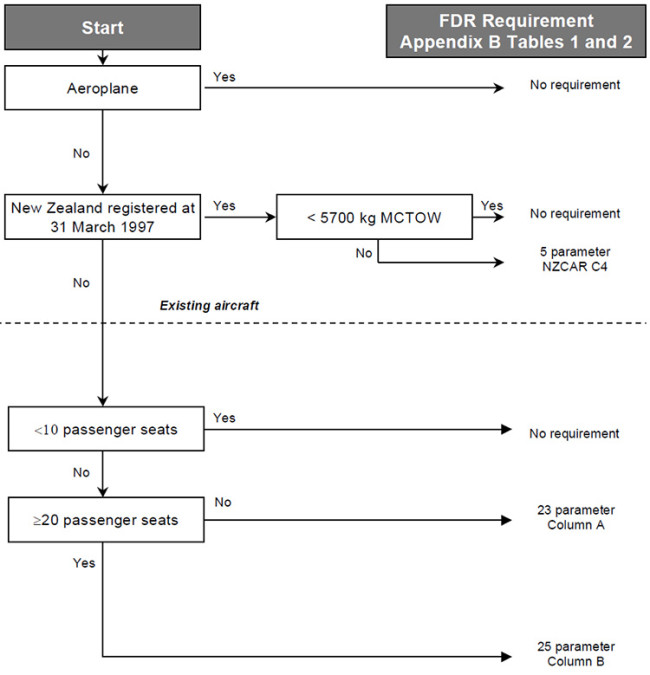
When reading the parameter specifications from Table 2 the corresponding shaded specification should be chosen for each parameter. This table refers to the FDR requirements of rule 135.369.
Table 1 PDF version [PDF 428 KB]
| (A) | (B) | |
|---|---|---|
| Parameter | 23 Parameter Helicopter | 25 Parameter Helicopter |
| 1 | Time | Time |
| 2 | Airspeed | Altitude |
| 3 | Altitude | Airspeed |
| 4 | Heading | Heading |
| 5 | Vertical acceleration | Vertical acceleration |
| 6 | Longitudinal acceleration | Pitch attitude |
| 7 | Pitch attitude | Roll attitude |
| 8 | Roll attitude | Radio transmitter keying |
| 9 | Altitude rate | Power in each engine: Free power turbine speed and engine torque |
| 10 | Main rotor speed | Main rotor speed |
| 11 | Free or power turbine for each engine | Altitude rate |
| 12 | Engine torque for each engine | Pilot input - primary controls |
| 13 | Primary hydraulic pressure | Flight control hydraulic pressure low |
| 14 | Secondary hydraulic pressure (if available) | Flight control hydraulic pressure selector switch position, 1st and 2nd stage |
| 15 | Radio transmitter keying | AFCS mode and engagement status |
| 16 | Autopilot engaged | SAS status - engaged |
| 17 | SAS status - engaged | SAS fault status |
| 18 | SAS fault status | Main gearbox temperature low |
| 19 | Collective | Main gearbox temperature high |
| 20 | Pedal position | Controllable stabilator position |
| 21 | Lateral cyclic | Longitudinal position |
| 22 | Longitudinal cyclic | Lateral acceleration |
| 23 | Controllable stabilator position | Master warning |
| 24 | Nav 1 and Nav 2 frequency selection | |
| 25 | Nav 1 and Nav 2 frequency selection |
This table refers to the FDR requirements of rule 135.369.
Table 2 PDF version [PDF 468 KB]
| Parameters | Range | Installed system minimum accuracy (to recovered data) 1 | Sampling interval (per second) | Resolution read out 2 |
|---|---|---|---|---|
| Relative time (from recorded on prior to take-off) | 25 hr minimum 24 hours |
±0.125% per hour | 1 0.25 |
1 sec |
| Indicated airspeed | Vmin to VD (KIAS) (minimum airspeed signal attainable with installed pitot/static system) As the installed measuring system |
±5% or ±10 knots, whichever is greater ±3% |
1 | 1 kt. |
| Altitude | -1,000 ft to 20,000 ft pressure altitude -1,000 ft to max certificated altitude of aircraft |
±100 to ±700 ft (see Table 1, TSO C51-a) | 1 | 25 to 150 ft 5’ to 30’ |
| Magnetic heading | 360° | ±5° ±2° |
1 | 1° 0.5° |
| Vertical acceleration | -3 g to +6 g | ±0.2 g in addition to ±0.3 g maximum datum ±1% of max range excluding datum error of ±5% |
4 (or 1 per second where peaks, ref. to 1 g are recorded) 8 |
0.05 g 0.01g |
| Longitudinal acceleration | ±1.0 g | ±1.5% max. range excluding datum error of ±5% | 2 4 |
0.03 g 0.01g |
| Lateral Acceleration | ±1.0 g | ±1.5% max. range excluding datum error of ±5% | 4 | 0.01g |
| Pitch attitude | 100% of usable range ±75° |
±2° | 1 2 |
0.8° 0.5° |
| Roll attitude | ±60° or 100% of usable range, whichever is greater ±180° |
±2° | 1 2 |
0.8° 0.5° |
| Altitude rate | ±8,000 fpm ±6,000 fpm |
±10% Resolution 250 fpm below 12,000 ft indicated As installed |
1 2 |
250 fpm below 12,000 0.2% |
| Engine power each engine | ||||
| Main rotor speed | Maximum range 0-130% |
±5% ±2% |
1 2 |
1% of full range 0.3% of full range |
| Free or power turbine | Maximum range 0-130% (power Turbine Speed) |
+5% +2% |
1 (per engine) | 1% of full range 0.2% to 0.4% of full range |
| Engine torque | Maximum range | ±5% ±2% |
1 (per engine) | 1% of full range 0.2% to 0.4% of full range |
| Flight Control - Hydraulic Pressure | ||||
| Hydraulic Pressure Low | Discrete, each circuit | 1 | ||
| Hydraulic Pressure Selector Switch Position, 1st and 2nd Stage | Discrete | 1 | ||
| Primary (discrete) | High/low | 1 | ||
| Secondary - if applicable (discrete) | High/low | 1 | ||
| Avionics | ||||
| Radio transmitter keying (discrete) | On/off | 1 | ||
| Autopilot engaged (discrete) | Engaged or disengaged | 1 | ||
| AFCS Mode and Engagement | Discrete (5 bits necessary) | 1 | ||
| SAS status - engaged (discrete) | Engaged/disengaged | 1 | ||
| SAS fault status (discrete) | Fault/OK | 1 0.25 |
||
| Flight Controls | ||||
| Collective | Full range | ±3% | 2 | 1% of full range 0.5% of full range |
| Pedal position | Full range | ±3% | 2 | 1% of full range 0.5% of full range |
| Lateral cyclic | Full range | ±3% | 2 | 1% of full range 0.5% of full range |
| Longitudinal cyclic | Full range | ±3% | 2 | 1% of full range 0.5% of full range |
| Controllable stabilator position | Full range | ±3% | 2 | 1% of full range 0.4% of full range |
| Main Gearbox Temperature Low | As installed | As installed | 0.25 | 0.5% of full range |
| Main Gearbox Temperature High | As installed | As installed | 0.5 | 0.5% of full range |
| Master Warning | Discrete | 1 | ||
| Nav 1 and Nav 2 Frequency Selection | Full range | As installed | 0.25 | |
| Outside Air Temperature | -50°C to +90°C | ±2°C | 0.5 | 0.3°C |
1. When data sources are aircraft instruments (except altimeters) of acceptable quality to fly the aircraft the recording system excluding these sensors (but including all other characteristics of the recording system) must contribute no more than half of the values in this column.
2. This column applies to aircraft manufactured after October 11, 1991.
This Appendix is referred to in rule 135.77.
To determine the minimum runway width it is necessary to ascertain the aerodrome reference code (ARC) appropriate to the aeroplane type by using Table 1. The code is composed of two elements which are related to the aeroplane performance, characteristics, and dimensions. Element 1 is a number based on the aerodrome reference field length (ARFL) and element 2 is a letter based on the aeroplane wingspan and outer main gear wheel span.
(a) Firstly: Determine the ARFL of the aeroplane to be operated. The ARFL is the minimum field length for take-off at maximum certificated take-off weight, at sea level, in standard atmospheric conditions, in still air, and with zero runway slope, as derived from the aircraft flight manual;
(b) Secondly: Determine the code number for element 1 applying the aeroplane’s aerodrome reference field length; and
(c) Thirdly: Determine the code letter of element 2 corresponding to the dimensions of the aeroplane’s wing and outer main gear span. The code letter for element 2 is the code letter which corresponds to the wingspan, or the outer main gear span, whichever gives the most demanding code letter. For instance, if code letter C corresponds to the aeroplane’s wingspan and code letter D corresponds to the aeroplane’s outer main gear span, the code letter selected would be D for that aeroplane type.
| Code Element 1 | Code Element 2 | |||
|---|---|---|---|---|
| Code Number | Aeroplane Reference Field Length | Code Letter | Wing Span | Outer Main Gear Wheel Span |
| 1 | Less than 800 m | A | Up to but not including 15 m | Up to but not including 4.5 m |
| 2 | 800 m up to but not including 1200 m | B | 15 m up to but not including 24 m | 4.5 m up to but not including 6 m |
| 3 | 1200 m up to but not including 1800 m | C | 24 m up to but not including 36 m | 6 m up to but not including 9 m |
| 4 | 1800 m and over | D | 36 m up to but not including 52 m | 9 m up to but not including 14 m |
| E | 52 m up to but not including 65 m | 9 m up to but not including 14 m | ||
Having determined the aeroplane’s ARC, the runway widths are determined by entering at the applicable code number and then moving across to the value under the applicable code letter. For instance, if the aeroplane ARC is 2C, the required runway width is 30 m.
| Code Letter | |||||
|---|---|---|---|---|---|
| Code Number | A | B | C | D | E |
| 1 | 18 m | 18 m | 23 m | - | - |
| 2 | 23 m | 23 m | 30 m | - | - |
| 3 | 30 m | 30 m | 30 m | 45 m | - |
| 4 | - | - | 45 m | 45 m | 45 m |
A holder of an air operator certificate must carry out the following procedures under rule 135.233(b)(2) for calculating the landing distance where a runway is dry:
(a) A holder of an air operator certificate must ensure that, for each aeroplane it operates, the landing weight for the estimated time of landing allows a full-stop landing from 50 feet above the threshold within 70% of the landing distance available assuming that the aeroplane is landed.
(b) When calculating the landing weight under paragraph (a), a holder of an air operator certificate must take account of—
(1) aerodrome elevation; and
(2) ambient temperature at the aerodrome; and
(3) the type of runway surface and the runway surface condition; and
(4) the runway slope in the direction of landing; and
(5) not more than 50% of the reported headwind component or not less than 150% of the reported tailwind component.
(c) For an aeroplane to land as specified in paragraphs (a) and (b), it is assumed that the aeroplane will land on the most favourable runway taking into account—
(1) the forecast meteorological conditions; and
(2) surrounding terrain; and
(3) approach and landing aids; and
(4) obstacles within the missed approach flight path.
(d) If the holder of an air operator certificate is unable to comply with paragraph (c) for the destination aerodrome, the aeroplane may be dispatched if an alternate aerodrome is designated that permits compliance with paragraphs (a), (b), and (c).
A holder of an air operator certificate must carry out the following procedure under rule 135.233(b)(2) for calculating the landing distance where a runway is wet or contaminated –
ensure that, for each aeroplane it operates, when the relevant weather reports or forecasts or a combination of them, indicate that the runway at the estimated time of arrival of its aeroplane may be wet or contaminated, the landing distance available is at least 115% of the landing distance required by paragraph D.1.
