
How unattended aerodromes operate when the builders arrive.
Aerodrome upgrades bring pressure, uncertainty, and competing priorities. Safety in these situations demands clear roles, good communication, and realistic assumptions about how pilots will behave. Feilding and Hood aerodromes show how that looks in practice.
When NOTAMs aren’t enough
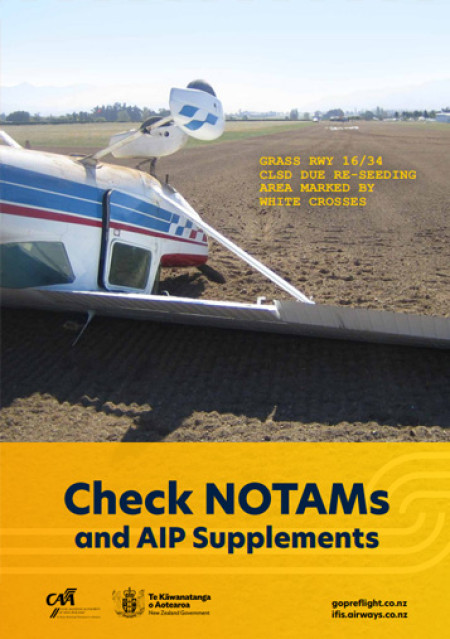
Visit our safety education posters page for this poster and more.
Real-world aviation doesn’t always behave the way the system assumes it will. When Feilding Aerodrome committee prepared to reseal the runway, they recognised early that managing risk would depend on how information was communicated and reinforced during disruption.
Feilding is a busy, member-owned aerodrome run and managed entirely by volunteers. It supports engineering companies, commercial operators, Feilding Aviation flight training school, flying clubs, visiting recreational pilots, and Massey University School of Aviation. During the works, that mix of activity became an active risk to address.
What was expected to be a two-week reseal stretched to nearly two months due to weather and other constraints. Extended disruption matters because certainty erodes over time, increasing the risk of misunderstanding, complacency, and unsafe assumptions.
NOTAMs remained a core control throughout the project, but the committee accepted early that NOTAMs alone would not manage the risks.
“Not everyone reads NOTAMs, and we planned for that,” says aerodrome committee member Peter Flintoff, who led the project and the communications effort. “Some pilots skim them. Some pilots miss them entirely.”
But NOTAMs were treated as one defence among many, and Peter worked closely with the Airways’ NOTAM office to get updates issued quickly.
Regular email updates were sent to aerodrome members and key users, repeatedly reinforcing messages – the runway is closed, timelines may shift, check NOTAMs, expect disruption.
“I’d rather over-communicate than under-communicate,” Peter says. “If it affects safety or planning, people need to know.”
Physical cues reinforced the message at the point of pilots’ final decision-making. White crosses were placed on the runway, cones were deployed, and runway lighting was disabled at night so the aerodrome did not look available after dark.
Another important control was highly effective – a single, clearly identifiable person responsible for safety during the works.
Peter estimates he was at the aerodrome more than 90 percent of the time during the works – monitoring radio traffic where possible, meeting the resealing contractors daily, and dealing with issues on the spot.
Safety and coordination were handled as a team effort. As project lead, Peter worked closely with the aerodrome committee, kept the president informed, and liaised with the safety representative as plans changed. Clear roles and regular communication helped make sure the contractors understood aerodrome operating procedures, and risks were addressed promptly.
Despite all this, human behaviour remained the dominant risk.
In one case, a pilot ignored the white crosses and landed on the closed runway because they couldn’t see any people or vehicles. Fortunately, the resealing teams had just finished up for the day.
In another case, a pilot misidentified the grass area next to the sealed runway as an airstrip and landed on it, narrowly avoiding aircraft damage.
In both cases, NOTAMs were in place prohibiting landing, but the pilots had not read them.
Hood aerodrome – when upgrades and certification align
At Hood aerodrome in Masterton, major runway and airfield upgrades coincided with a decision to move towards aerodrome certification, aligning physical change with a more formal approach to managing risk.
A $17 million1 programme delivered obvious physical change. But just as significant was the requirement to demonstrate – through systems, defined roles, and day-to-day practice – that safety was being consistently managed across a busy, mixed-use aerodrome.
A tragedy that changed the conversation
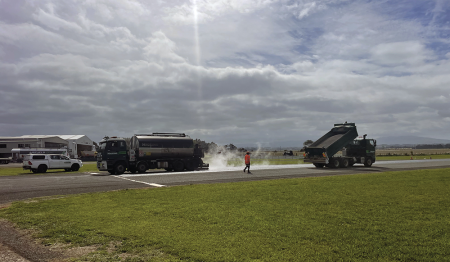
Runway resealing at Feilding aerodrome. Photo courtesy of Peter Flintoff.
That shift followed a mid-air collision at the aerodrome in 2019 with two fatalities. Masterton District Council’s subsequent aerodrome ‘masterplan’ helped map out how safety and infrastructure improvements would be made. In 2023, CAA formally recommended the council – the aerodrome’s owner and operator – move towards being a qualifying aerodrome2.
To future-proof the aerodrome for growth, and to demonstrate a serious commitment to safety, the council decided to go a step further and move towards Part 139 aerodrome certification.
Aerodrome Chief Executive Ian Osland says that decision expanded the project well beyond runways, lighting, and other structural work.
Certification, which CAA approved in late 2025, required the council to clearly document how the aerodrome operates, who’s responsible for what, and how risk is identified and managed. That included developing an aerodrome operations manual, a formal safety management system and emergency procedures, along with clearer airside and groundside controls.
During the runway upgrade works, sections of the sealed runway were closed at different times to allow for widening, resurfacing, and lighting installation.
Closures were notified by NOTAM and marked on the runway with white crosses. User groups were updated regularly by newsletter.
Throughout the project, a grass runway remained open so air ambulance and other essential flights could continue.
Ian recalls an incident when a general aviation pilot, running low on fuel, attempted to land while the sealed runway was closed. The aircraft didn’t land on the closed surface and instead landed on the grass runway, which had been kept open for emergency services, avoiding a possibly more serious event.
This illustrates how operational pressure affects decision-making. Low fuel is a risk factor in itself – when pilots are under that kind of pressure, even well-communicated closures and physical markings can be missed or misinterpreted.
Keeping the grass runway open throughout the works proved critical, providing an option that absorbed risk when circumstances didn’t line up as intended.
Including users in the safety system
Part 139 certification requires aerodromes to have an effective process for consulting users. At Hood, a formal aerodrome user group was already in place, bringing together representatives from agricultural aviation, flight training, emergency services, skydiving, and general aviation. To meet certification requirements, a dedicated safety group was also established.
Meeting in structured, independently chaired forums, both groups proved valuable – beyond regulatory compliance. They demonstrated the importance of structured engagement, particularly during periods when routine operations were disrupted by major works.
“I wasn’t here at the start of the project,” Ian says, “but if I could go back in time, the project steering group would include earlier representation from aerodrome users. They’re the ones flying in and out regularly. Their practical insights into making changes and upgrades happen are invaluable.”
Hood’s emergency role
The physical upgrades – including a widened runway, upgraded lighting, sealed taxiways, and expanded apron space – have improved reliability for emergency operations, particularly at night and in low-visibility conditions.
That reliability matters beyond normal operations, with Hood also identified as a potential staging point during major regional emergency disruptions, including earthquakes.
What the projects revealed
Even with certification, new infrastructure and detailed procedures, risk doesn’t disappear. Safety during disruption depends on understanding how people behave, and designing systems that reflect that reality.
At both Feilding and Hood, infrastructure change didn’t just reshape physical assets – it revealed how safety is communicated, shared, and managed, and how aerodrome operators reinforce controls when routines no longer apply.
Footnotes
1 The programme was funded by the government and Masterton District Council.
2 Qualifying aerodromes are those which CAA has formally accepted as suitable for specific aircraft operations.
Main photo courtesy of Masterton District Council.