
Rick Graham was once, in his own words, “not very good with the rules and compliance”. This year, he won the Director’s Award for his approach to safety.
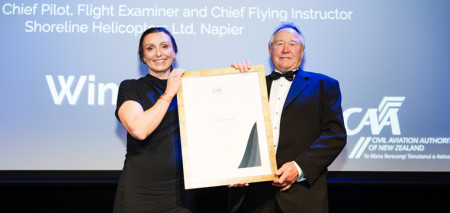
Acting Director of Civil Aviation, Catherine MacGowan, presents Rick Graham with his Award.
Now owner of Part 141 trainer Shoreline Helicopters, he started in deer recovery in the 70s. He admits he took all the risks we associate with that tragic era.
But in the 50 years since, he’s done a complete 180. A few weeks ago, he won the Director’s Award at the Aviation Industry Association Awards Gala, which acknowledged his contribution to safe aviation.
Rick, who’s accumulated 20,000 hours of flying in every form of operation (except IFR), started out in 1976.
In his award acceptance speech, and to much laughter, Rick told the glammed-up audience that during those early years of flying, “The CAA and I were not good friends”.
He explained to Vector that his problems were compliance, paperwork, and attitude.
“When the CAA said they were coming to audit my operation, I told them I’d tell them when I was ready for an audit.”
Rick realised that this approach was putting his certification in danger, and he very much wanted to continue flying, and having a business in aviation.
“I had to do something to get myself out of the bother I was in. I decided the way to do that was to get better at knowing the rules, even better than the auditors. So I studied and studied and studied.”
That was his motivation – to know as much about the rules, if not more, than the CAA auditors – almost as an academic exercise.
But an unexpected thing happened. All that rules homework led Rick to realise that the saying, ‘Aviation rules are written in blood’ had merit. And his motivation moved from just wanting to be compliant to stay in business, to valuing safety for its own sake.
Today, Rick is widely regarded as one of New Zealand’s most experienced helicopter pilots, instructors, competency assessors, and mentors.
The Director of Civil Aviation, Kane Patena, said of him, “What sets Rick apart is his ability to turn every flight into a learning opportunity.
“Pilots consistently speak of the practical knowledge, safety insight and … experience he brings to every assessment and training flight.
“Whether discussing advanced flying techniques, hazard identification, or risk management, Rick challenges pilots to think critically and to continually improve.”
Quite the 180.
“Poacher turned gamekeeper”
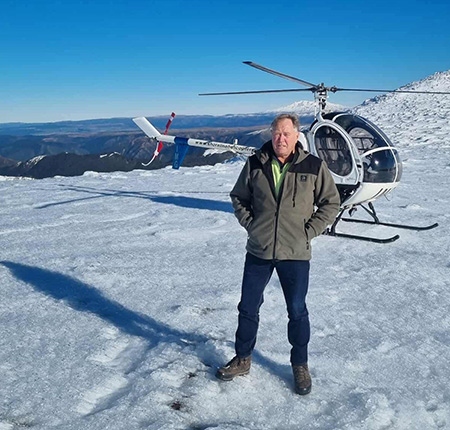
Photo courtesy of Shoreline Helicopters
“I’d had a B-cat instructor’s rating for quite a few years,” says Rick, “and that's all I’d ever needed. But once I started getting good at the rules and changing my way of thinking, and got better at everything, I thought, ‘I need to start passing some of this on’. And that’s when I decided I’d do a flight examiner rating. And with all the study I’d been doing, I was more than confident with the theory side of it, especially with the rules.”
It’s apparent that Rick relishes a challenge. Some in the aviation community, who’d known him from the deer recovery days, mocked his determination to become an A-cat.
“They said I was the ‘poacher turned gamekeeper’ but that just motivated me more.”
Rick, who’d once determined to be the best deer recovery pilot he could be, told a mentor that, now, he was going to be “…the best flight examiner in New Zealand”.
Well, you don’t get a Director’s Award for nothing.
Kane Patena said of Rick, “He’s known for setting high standards and expecting pilots to meet them, while tailoring his training and assessments to the realities of the operation they are flying. Just as importantly, he remains a trusted source of advice and support long after formal training or assessment is complete.
“His extensive operational experience has enabled him to bring valuable real-world safety lessons into pilot training and assessment programmes. Pilots trained by Rick have gone on to successful careers in New Zealand and around the world.
“Beyond the hundreds of pilots who have benefited directly from his instruction, assessment and mentoring, Rick has helped foster a culture of learning and safety across the helicopter industry.
“His willingness to share lessons learned, speak up when standards can be improved, and recognise excellence when it’s demonstrated has earned him deep respect from pilots and operators throughout New Zealand.”
From easy-going to tough
Rick is the sole instructor at Shoreline Helicopters and is supported by only Gail, his wife and administrator, and Emma Tilyard – from Spray Technologies 2025 – who is his safety manager.
It may be a small operation but clearly a successful and busy one. His utter commitment to safety and skills means that in 40 years of training, he’s turned out a significant number of safe, confident, and highly competent pilots in New Zealand and the Pacific.
Rick says his own transformation has been against the backdrop of big changes in New Zealand’s whole flying culture.
“I do sometimes pass on to my students the old stories and say, ‘It’s not like that now, the culture has changed and this is how everybody does it in the 21st century’.
“Just so they know that there’s somebody who’s been through those sorts of days and has changed with the changing times.
“But today’s students are actually in a different culture from that of 50 years ago. They’re quite risk-averse and that’s a good thing.”
Nevertheless, Rick expects great things from them, and has failed high-hours pilots on their flight crew competency checks, if they haven’t made the grade.
“It’s about being precise,” says Rick. “And maintaining a standard. Near enough is not good enough for me. It’s got to be perfect, all the time.”
Rick may be tough but says it’s important to him that every time he signs a logbook, it’s a ‘good’ signature.
“If I don’t sign, there’ll be a reason for it.
“And, knowing that, I sleep very well at night.”
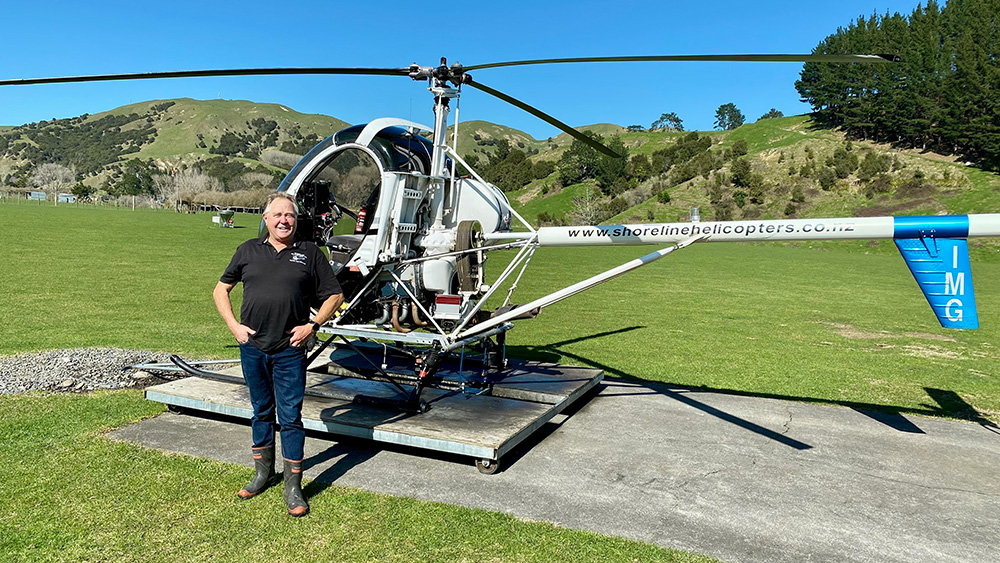
Photo courtesy of Shoreline Helicopters