
There have been 26 reports of close calls in Class G airspace, while enroute, since the beginning of 2025.
Here are observations from some of them. You’ll find there’s a theme...
"I estimate we would have passed within 50ft of each other with no avoiding action but with the descent made I estimate we passed within 100ft… I did have some shock afterwards."
"The aircraft was not on ADS-B or flight radar... I don’t recall hearing any radio calls from this aircraft."
"I had a near miss with ZK-XXX while overhead the Hawea area. I didn’t hear any radio calls from XXX and was alerted to the aircraft on my ADS-B."
"No radio position or traffic calls were heard from ZK-XXX on the relevant frequency before, during, or after, the encounter."
"I saw the aircraft turn back and begin orbiting overhead Feilding township with no radio calls. I tried to establish coms multiple times, but they never replied."
While most reported close calls in uncontrolled airspace occur around aerodrome circuits, a growing number are happening in the ‘great blue beyond’ – and that’s very much worrying the CAA.
In total, there were about 112 reported close calls in uncontrolled airspace, from 1st January 2025 to 31st May, 2026. So the 26 of those happening in cruise represents about one in four. That’s quite a number, given how big the sky is.
Nevertheless, it appears even experienced pilots can miss traffic in Class G airspace.
Separation very much relies on your vigilance – particularly en route when the sky appears huge and empty, and you feel you can relax a little.
But it’s said that, if you can see it, you can avoid it. The real risk is the traffic you don’t see (see footnote). Close calls often occur, not because nobody ‘looked out’, but because various factors combined to reduce situational awareness – the key cause of near collisions.
Poor scanning, complacency, high closing speeds
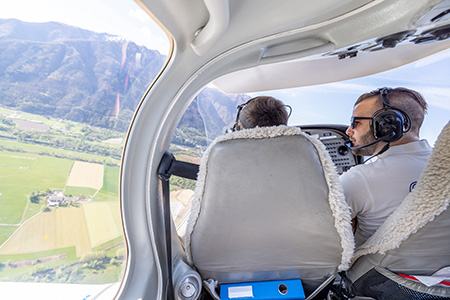
Analysis of enroute close calls indicates that in half of them, the pilots didn’t hear any calls from the other aircraft. Photo: iStock.com/Mystockimages.
Joint Massey University and CAA research, published in 2024, found that not maintaining an effective lookout is one of the leading contributors to mid-air collisions.
Complacency has also been identified as a risk, especially in the cruise. Pilots assume there’s little chance of other traffic, and reduce their scan rate or depth. Or they’re flying in familiar areas and have been there many times before, have done this many times before, ‘nothing bad happened, it won’t this time’.
So we ‘go through the motions’ of scanning, which is more like a long fixated stare than systematic sector scanning.
According to the FAA (see diagram), a pilot has 12.5 seconds to identify and react to a nearby aircraft.
Some of that precious 12.5 seconds can be used up by inaction, if the pilot is hit by the startle effect.
And that precious 12.5 seconds may be further reduced if the other aircraft is a fast one, able to close rapidly.
So familiarise yourself with what an effective scan actually entails. The Vector article So you think you can see and avoid (March/April 2015) has a good description.
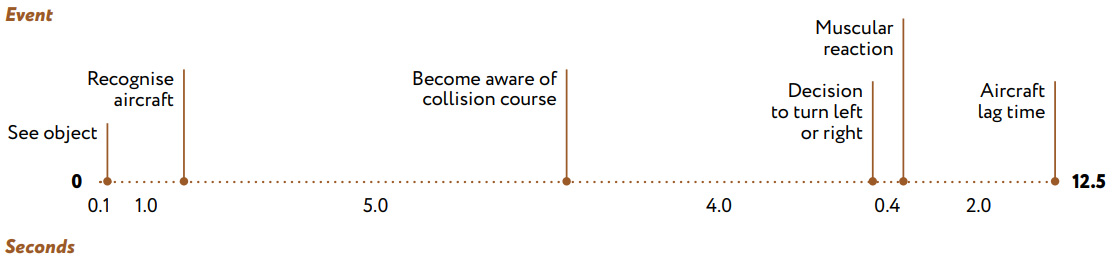
Aircraft identification and reaction time. Source: FAA AC 90-48D CHG 1 Pilots’ role in collision avoidance.
Human limitations
Another major reason for reduced situational awareness is the limitations to our eye-and-brain visual system – even when we’re intentionally looking outside the aircraft.
These limits include:
- Despite a total field of view of up to 200 degrees, the very narrow focus area of humans is only about 10 to 15 degrees of sharp vision.
- Empty field myopia – staring into empty sky without really focusing, so traffic isn’t perceived. When there are no clear visual objects to focus on, the eye tends to ‘rest’, focusing a few feet in front of us – nearer in poor visibility conditions – and that means distant objects may be harder to detect. This can prevent us seeing oncoming aircraft.
- The human pilot’s slow refocusing ability – one to two seconds between cockpit and outside.
- Expectation bias – the brain may see only what it expects to see.
- If traffic on a collision course maintains a constant relative bearing, it will appear stationary in the windscreen and may be difficult to detect.
These all combine so that an aircraft can be directly ahead of yours, and even then, you won’t notice it.
The Vector article Things that jeopardise your lookout (Spring 2023) advises that we need to ‘stretch’ our vision, “…allowing our focus to improve as we steadily look further and further into the distance.
“For example, if you look out to the wing for a few seconds, then further down the wing, then beyond the wing, you’ll find your focus will sharpen.”
Aircraft limitations
Close calls can also result from aircraft geometry.
Cockpit structure, wings, and nose, can all create significant blind spots, especially during climb or turns.
You may have great scanning skills, but could still miss a nearby aircraft if you don’t clear blind spots created by the aircraft’s geometry.
You need to carry out some active manoeuvring to clear such a blind spot. Deliberately turn, climb, and descend, moving your head widely while doing so.
Poor radio practice
Ongoing CAA analysis of 207 reported enroute close calls indicates that in 50 percent of them, the pilots reported they didn’t hear any calls from the other aircraft. And 15 percent of them involved poor radio practice, such as insufficient calls, late calls, barely readable calls, or misreporting of position.
Never assume others know where you are. For the reasons above, they may not have seen you, or their aircraft is not equipped with ADS-B – or it is equipped with ADS-B, but it’s switched off. So making clear radio calls, and actively monitoring incoming radio calls, should become your standard practice, even when flying in the cruise.
And, always having your transponder selected to ALT – if it’s not automatic – during flight will help other pilots who are using some form of traffic avoidance system to ‘see’ you and avoid you.
And now...
Read So you think you can see and avoid (Vector March/April 2015)
Read Things that jeopardise your lookout (Vector Spring 2023)
Read The surprising findings on mid-air collisions in uncontrolled airspace (Vector Summer 2024)
Order your free Plane talking GAP booklet
Refresh your knowledge of the messages from the Work Together, Stay Apart campaign. Many of the WTSA concepts apply in enroute uncontrolled airspace as well.
Footnote
Interviews between the FAA and 658 pilots who survived a mid-air collision found that 88 percent of them never saw the other aircraft before they collided. The remainder saw the other aircraft, but too late to initiate avoiding action.
Main photo courtesy of Aaron Pearce.