
So, maintain it and back it up.
CAA staff sometimes hear from worried pilots whose logbooks have been damaged, misplaced, or – in one memorable case – accidentally thrown out with the rubbish.
CAA Aviation Safety Advisor Carlton Campbell says that apart from being a legal document, the pilot logbook has several practical applications that improve safety. This adds another reason for treating the logbook with ultimate care.
Logbooks contribute to safety
“A pilot’s logbook, when completed correctly, maintains a record of recent flight experience currency. If a pilot is looking to hire an aircraft, for example, the logbook is an important part of how the operator determines the pilot’s readiness to do the flight.
“The logbook gives the operator the ability to authorise a solo flight (or not), because they can determine the pilot’s currency, whether it be IFR, VFR, aircraft type, or the activity they want to do.
“For example, with type familiarity, a pilot must have done three take-offs and landings in the last 90 days. Their logbook will show that.
“For pilots who are intermittent in their training, the logbook reminds them what they’ve done and where they’re up to,” says Carlton.
“They might need to check back, asking, ‘Have I flown in the last 90 days? No, I haven’t, so I must go and do three take-offs and landings’. Or, ‘Yes I have, but it was two months ago so I had better do some revision or ask an instructor to check me out’.”
Employers will also use a pilot’s logbook to determine a candidate’s suitability for a role, so it’s crucial the logbook provides a true and accurate record of their experience and currency.
The logbook as a training record
Pilot logbooks also play a vital role in flight testing, Carlton says.
“More detail rather than less detail is important. A trainee pilot might just enter ‘circuits’ in the logbook, rather than saying ‘circuits, including flapless glide approaches’, or ‘circuits, including engine failure after take-off’.
“It’s vital to include more detail about what the circuit training entailed, because the logbook is the legal training record. It’s the legal document that’s assessed when it comes to a pilot doing a flight test.”
A flight test candidate should turn up for the test with each page in their logbook tallied up and certified by them as being true and accurate, Carlton adds.
“A logbook summary is an eligibility requirement for the flight test, and lots of people turn up for the test without having done that. In that circumstance, the flight examiner is entitled to decline to do the test.”
Instructors play a key role
Instructors have a crucial role in giving trainee pilots sound guidance on keeping a good logbook, Carlton says.
“It would be great to see more instructors more regularly monitoring their students’ logbook entries and giving ongoing advice,” he says, adding that it helps students develop good behaviours that will last them a lifetime.
“Teaching people to respect the logbook, to complete it in a way that records their flying experiences accurately and correctly, is very, very important,” Carlton says.
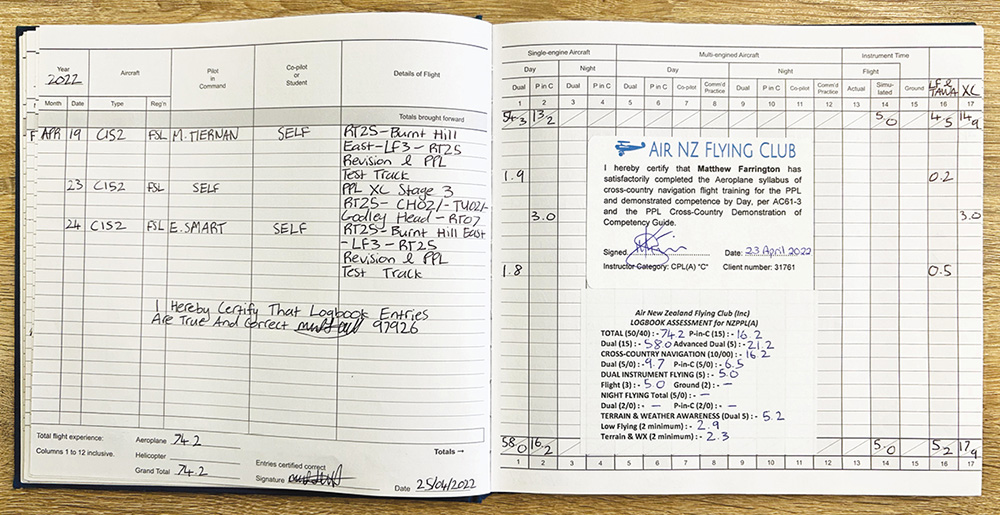
An example logbook, including a logbook assessment.
Compliance factors
If a pilot is involved in an accident or serious incident, the CAA inspector in charge of the investigation will ask to see the pilot’s logbook.
Carlton says a logbook that isn’t thoroughly maintained can expose the pilot to the risk of misinterpretations during an investigation.
Pilots also need to understand how to correct their logbook.
“Falsification of a logbook entry is an offence. So, for example, if you make a mistake in the logbook, you put a single horizontal line through the error and then write the correction, so that both entries can be seen. Don’t scribble out or white out the mistake,” Carlton explains.
“Some pilots have been known to tear pages out of their logbook. That opens them up to suggestions of illegal behaviour.”
He says the front of every pilot logbook has two pages of guidance on how to fill in your entries, so that’s worth reading or reviewing to keep yourself on track.
Protecting your logbook
Carlton doesn’t go as far as saying to protect your logbook with your life, but he comes close.
“Pilots should develop habits around the use, transport and storage of their logbook that protects it and doesn’t run the risk of it being lost, stolen or damaged.
“Reconstructing a logbook is very challenging. If you end up with multiple logbooks as your career progresses, rebuilding a logbook is near impossible.”
CAA Aviation Safety Advisor Richard Lane says, “It’s now possible to seek approval under rule 61.29(h) to use an electronic logbook, so long as all the requirements in the rule are met. But a paper logbook will probably be what many pilots continue to use, for some time to come.
“If a pilot loses their logbook and doesn’t have a backup, they can quickly find themselves in a difficult position, particularly pilots early in their careers who need an accurate record of their hours to progress.”
Richard says in one recent case, a pilot was able to recover their flying history through a paid FlightRadar24 account, which allowed them to look back at aircraft registrations and flight details. But relying on luck or third-party records isn’t a good plan.
A simple backup habit can save a great deal of stress, Richard says.
“Pilots may want to also keep an electronic logbook or use one of the apps available. But make sure it’s approved – and backed up – if you want the electronic record to be your “official’ logbook. If you’re sticking with paper for now, another safeguard may be taking a quick photo of each completed page of the paper logbook and storing it in a dedicated folder, or on a USB stick kept somewhere secure. If the worst happens, those images can make reconstructing the official logbook easier.”
Flight tests also record a pilot’s certified flying hours, and the CAA records that on the pilot’s file. That’s another way of creating a logbook using verified information from a lost one.
“Your logbook is a valuable document, and for many pilots it represents years of hard work. A few seconds spent on a backup can prevent a major headache later,” Richard says.
Now...
Read rules 61.29, 61.31, and 61.33 because they specifically discuss pilot logbooks.
Go to Rule Part 61 Subpart A General
Buy your CAA 1373 Pilot Logbook from your flight training organisation, or order directly from vertia.co.nz/collections/caa(external link)
Call Vertia free on 0800 GET RULES (0800 438 785), or email info@vertia.co.nz.
Footnote
Main photo iStock.com/Wirestock